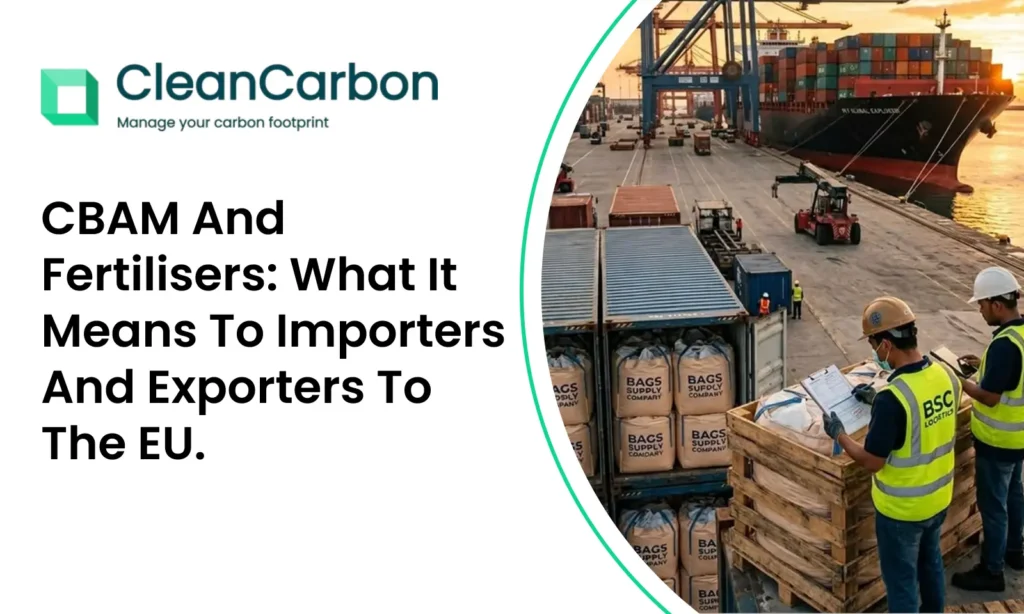
From 2026, the CBAM and fertilisers will put a carbon price on the emissions from nitrogen fertilizers imported into the EU. Importers must be approved to declare and report emissions, including CO₂ from ammonia and N₂O from nitric acid, and submit certificates. Exporters will need to provide accurate data and lower their carbon emissions to remain competitive. Products with high emissions, such as urea, may have high certificate costs, prompting both importers and exporters to improve data quality and adopt cleaner production methods. The first major deadline is the annual declaration and certificate submission due on 30 September 2027 for 2026 imports.
CBAM and Fertilisers: What It Means to Importers and Exporters to the EU
The EU Carbon Border Adjustment Mechanism (CBAM) started its final phase on 1 January 2026. Fertilizers are important among the six covered sectors because they have high emissions, include both CO₂ and N₂O, and are essential for European farming and food safety. Understanding CBAM and fertilisers is now essential for any company importing or exporting ammonia, urea, ammonium nitrate, nitric acid, or mixed nitrogen fertilizers into the EU.
This guide explains what CBAM for fertilisers requires, how embedded emissions are calculated, the practical implications for EU importers (authorised declarants) and non-EU exporters, cost considerations, compliance steps, and strategies to manage the new carbon liability. An FAQ section and short summary are included at the end.
Why Fertilizers Are Covered under CBAM
Fertilizers are included because making them, especially nitrogen fertilizers, uses a lot of carbon and can lead to carbon emissions. The main process starts with making ammonia using the Haber-Bosch method, which needs a lot of natural gas for both material and energy. Products like urea, nitric acid, and ammonium nitrate create more emissions, including nitrous oxide from nitric acid plants, which warms the planet 265 times more than CO₂.
The products covered (mainly under CN chapters 28 and 31) include anhydrous ammonia, urea, ammonium nitrate, calcium ammonium nitrate, UAN solutions, nitric acid, and some mixed fertilizers with nitrogen. There is a 50-tonne yearly net-mass minimum for fertilizers (combined with other CBAM goods), but most commercial importers exceed this limit.
Both direct emissions (from the process and burning) and indirect emissions (from using electricity) are priced for fertilizers—one of only two CBAM sectors managed this way.
Obligations for EU Importers (Authorised CBAM Declarants)
From 1 January 2026, only authorised CBAM declarants may import covered fertilizer goods above the threshold. Key requirements include:
- Holding authorised declarant status (applications were prioritised through early 2026 with a grace period).
- Collecting and reporting the total quantity of each type of fertilizer imported and the associated embedded emissions.
- Submitting an annual CBAM declaration by 30 September of the following year (first deadline: 30 September 2027 for 2026 imports).
- Purchasing and surrendering CBAM certificates corresponding to the reported embedded emissions (certificate sales opened in February 2027). Certificates are priced according to EU ETS allowance averages.
- Adjusting for any carbon price already paid in the country of origin and for the free-allocation equivalent under the EU ETS phase-out rules.
Importers should use real checked emissions data whenever they can. Default values are still available but are set quite high, which makes certificate costs go up. Verification must be done by approved third-party verifiers.
Implications for Non-EU Exporters
Exporters have no direct legal obligation under CBAM. However, the commercial reality is that CBAM for fertilisers shifts significant pressure upstream. EU buyers want detailed emissions data from installations, verification reports, and often lower prices to cover certificate costs. Exporters who cannot provide this data may face higher costs for importers or lose contracts to competitors with lower emissions.
Practical steps for exporters include:
- Setting up strong tracking systems for natural gas usage, emissions from processes, and N₂O from nitric acid units.>
- Creating emissions reports that match CBAM standards and helping with their verification.
- Looking into low-carbon options like green or blue ammonia to cut down on emissions and stay competitive.
How Embedded Emissions Are Calculated for Fertilizers
Emissions calculation starts at the ammonia stage and cascades to downstream products:
- Ammonia: Dominated by CO₂ from steam methane reforming (or coal gasification in some regions). Typical actual values range lower than the transitional default of around 2.68 tCO₂e per tonne.
- Urea: Incorporates ammonia emissions plus process CO₂, with adjustments for CO₂ uptake in the synthesis reaction. Embedded emissions are commonly cited in the 2.3–2.6 tCO₂e per tonne range.
- Ammonium nitrate and related products: Add N₂O emissions from nitric acid production, which can be material if abatement technology is limited.
- Indirect emissions from electricity are included and can vary significantly depending on the grid mix.
For complex goods, precursor emissions (especially ammonia) must be properly attributed. Actual data requires a monitoring plan, continuous or periodic measurement where relevant, and third-party verification.
Cost Implications and Market Effects
By early 2026, when the ETS prices reach about €75 for each ton of CO₂, the basic CBAM cost for urea could be around €180–200 per ton. Producers who work efficiently and can prove they have lower emissions will pay less. But those with high emissions will have to pay more, which can make products more expensive when they arrive and influence where they are bought from. This might eventually increase the cost of fertilizers for farmers in the EU.
Trade is already changing. Some big suppliers are facing more pressure, while those investing in making ammonia with less carbon or reducing N₂O emissions are getting an advantage. The mix of CBAM and other trade rules, like special tariffs, also affects how supplies are moved around.
Practical Compliance Roadmap
For importers:
- Confirm authorised declarant status and map all fertilizer CN codes.
- Engage suppliers early for installation-specific data and verification.
- Establish systems to track quantities, emissions, and carbon prices paid abroad.
- Model certificate needs and cash-flow impacts.
- Prepare the first annual declaration well ahead of the September 2027 deadline.
For exporters:
- Map production routes and quantify emissions according to CBAM methodology.
- Install or upgrade monitoring (especially for N₂O).
- Engage accredited verifiers and prepare transparent reports.
- Communicate verified data proactively to EU customers.
- Evaluate investments in lower-carbon production technologies.
Technology platforms that support supplier data collection, validation, and CBAM Registry-ready outputs are increasingly used by both sides.
Strategic Opportunities
While CBAM and fertilisers introduce costs, it also creates incentives for decarbonisation. Producers of green ammonia or fertilizers with strong N₂O abatement can differentiate themselves. Importers who secure verified low-emission supply chains reduce long-term carbon exposure and strengthen resilience. Over time, the mechanism is expected to accelerate the shift toward cleaner nitrogen production globally.
Conclusion:
CBAM for fertilisers is now a live commercial and regulatory reality. EU importers must manage authorisation, data collection, and certificate obligations, while non-EU exporters must deliver transparent, verifiable emissions information or risk losing market share. Companies that treat the mechanism as a driver for better measurement and lower-carbon nitrogen production will be best positioned to navigate the new landscape and maintain access to the European market.
Which fertilizer products are covered by CBAM?
Mainly nitrogen-based products including ammonia (CN 2814), urea (3102 10), ammonium nitrate, nitric acid, UAN, and certain mixed nitrogen fertilizers under chapters 28 and 31.
Do importers need to report both CO₂ and N₂O?
Yes. Direct CO₂ from ammonia production and N₂O from nitric acid production are included, along with indirect emissions from electricity.
What is the de minimis threshold for fertilisers?
50 tonnes of annual net mass (aggregated with other applicable CBAM goods such as steel, aluminium and cement). Electricity and hydrogen have no threshold.
When is the first certificate surrender due?
By 30 September 2027 for imports made in 2026. Certificate purchases became available from February 2027.
Can exporters reduce the CBAM burden on their customers?
Yes—by providing verified actual emissions data that is lower than defaults and by investing in lower-carbon production methods.
Are potash fertilizers (MOP/SOP) covered?
Pure potassium fertilisers are generally outside the current CBAM product scope, although mixed products containing nitrogen may be affected.