What a monitoring plan is, what the EU rules require it to contain, and what we have learnt writing them for Indian steel and aluminium exporters.
Since 1 January 2026, the EU’s Carbon Border Adjustment Mechanism (CBAM) is no longer a reporting exercise. EU importers of iron and steel, aluminium, cement, fertilisers, hydrogen and electricity now have to declare the embedded emissions of what they buy each year, and pay for them through CBAM certificates. The first annual declaration, covering 2026, is due in 2027.
For an exporter in India, this changes the question your EU customer is asking. In the transitional period it was “Can you send us a number?” Now it is “Can you send us a number that an accredited verifier will sign off?” If the answer is no, your customer falls back on EU default values. These are set conservatively, so they usually mean a higher carbon cost, and that cost tends to come back to you in the price negotiation.
The document that decides which of these two answers you can give is the CBAM monitoring plan. Below I explain what it is, what the regulation requires it to contain, and the practical lessons from the plans we have recently prepared for a stainless and alloy steel producer and a secondary aluminium producer.
CBAM Monitoring Plan Key takeaways
- A CBAM monitoring plan is the installation’s written rulebook for how embedded emissions are measured, calculated and attributed to each CBAM good.
- Its minimum content is set out in Annex II, point A.5 of Implementing Regulation (EU) 2025/2547: 22 requirements.
- Verifiers assess your emissions data against your MP. Without a sound MP, actual emissions are hard to verify, and the default values come into play.
- A good CBAM monitoring plan describes methods, not numbers. It stays valid all year while the quarterly and annual data change.
What is a CBAM Monitoring Plan?
A CBAM monitoring plan is a controlled document, owned by the installation operator (the producer outside the EU), that records how the installation determines the embedded emissions of the CBAM goods it produces. It answers questions like these:
- Which production processes does the installation have, and which CBAM goods (by CN code) come out of each?
- Where are the system boundaries, and which fuels, materials and precursors cross them?
- Which CBAM monitoring methodology applies to each source stream (calculation, mass balance or measurement), and which calculation factors are used?
- Which meters, weighbridges and laboratories produce the data, and how are they calibrated?
- How are emissions attributed to each process and good, and how are precursors carried through?
- Who is responsible for each step, and what quality controls stop errors from reaching your customer?
Think of CBAM monitoring plan as the installation’s standard operating procedure for carbon accounting. The emission figures go to the EU customer through the communication template every quarter and in the annual operator’s emissions report. The CBAM monitoring plan is the reference that shows how each figure was produced.
The regulatory basis
- Regulation (EU) 2023/956: the CBAM Regulation, as amended by the simplification Regulation (EU) 2025/2083.
- Implementing Regulation (EU) 2025/2547: rules for calculating embedded emissions and the monitoring methodology. Annex II, point A.5 lists the minimum content of the CBAM monitoring plan.
- Implementing Regulation (EU) 2025/2546: verification of declared embedded emissions.
- Implementing Regulation (EU) 2025/2621: default values, used when actual data are unavailable.
- Implementing Regulation (EU) 2025/2620: CBAM benchmarks for the free-allocation adjustment.
Why the CBAM Monitoring Plan Matters Now
1. It is what the verifier audits against
In the definitive period, actual embedded emissions declared by an EU importer have to be verified by an accredited verifier. The verifier does not start from your final number. It starts from your CBAM monitoring plan: it checks that the plan meets the regulation, that the plant actually works the way the plan says it does, and that the reported data follow the plan. If the MP is vague, incomplete or does not match what happens on the shop floor, the verifier cannot give a positive opinion, however carefully the numbers were calculated.
“A verifier does not audit your emissions figure. It audits the system that produced it, and the monitoring plan describes that system.”
2. It is the difference between actual and default values
Where verified actual data are not available, EU declarants must use the default values published by the Commission. These are set at a conservative level so that unverified data never look better than verified data. For efficient producers, such as a scrap-based electricfurnace steel plant or a secondary aluminium foundry, actual emissions are often far below the defaults. A sound MP is how you get credit for that.
3. It protects your customer relationships
EU importers are now choosing suppliers partly on the quality of their CBAM data. A supplier who can send a verified, consistent figure every quarter without last-minute corrections is easier to buy from than one who cannot. The MP is what keeps your figures consistent from one quarter to the next and from one customer to the next.
4. It makes the work repeatable
In many plants CBAM data are compiled by one or two people, often under deadline pressure. When those people change jobs, the knowledge leaves with them. A written MP that names data sources, formulas, responsibilities and checks lets anyone produce the same result, and a new team member can pick it up without starting from scratch.
What Goes Into a CBAM Monitoring Plan: the 22 Requirements
Annex II, point A.5 of Implementing Regulation (EU) 2025/2547 lists 22 requirements for the minimum content of a monitoring plan. In practice we group them into the building blocks below. Each block becomes a chapter of the CBAM monitoring plan, and we end the document with a crossreference table so the verifier can find every requirement quickly.
| Building block | What it covers | Typical evidence |
|---|---|---|
| Installation & goods | Operator and installation identification, production processes, CBAM goods by CN code, relevant CBAM benchmarks | Registry ID, address and coordinates, CN code list, process flow diagram |
| Boundaries & sources | System boundary per process, emission sources, source streams, precursors, exclusions with justification | Boundary diagram, source-stream list, precursor register |
| Methods & factors | Calculation, mass balance or measurement per source stream; NCVs, emission factors, carbon contents; sampling and laboratory requirements | Factor table with sources, sampling plan, lab accreditation |
| Measurement | Meters and instruments, how activity data and production levels are determined, data gaps and substitute values | Meter and calibration register, stock-reconciliation method |
| Attribution | Allocation of shared fuels and electricity, precursor carry-through, treatment of scrap and residues, heat and waste gases | Allocation rules, SEE formulas |
| Control system | Data flow, QA/QC, risk assessment, IT controls, segregation of duties, outsourced processes, records and version control (Req. 22 a–h) | Data-flow chart, risk register, review logs, revision history |
CBAM Monitoring Methodology Lessons From the Field
The two CBAM monitoring plans we finished recently are quite different from each other. One is for a scrap-based stainless and alloy steel producer with three production processes. The other is for a secondary aluminium producer with two linked installations and eight production processes. Together they show most of the issues an Indian exporter is likely to run into.
Lesson 1: Get the production processes right first
Everything in the MP depends on how you divide the installation into production processes. The rule is one process per aggregated goods category and group of goods with the same production route. In the steel plant this gave a clean chain: P1 crude steel (ingots and billets) → P2 hot-rolled long products → P3 bright bars. Billets from P1 are the precursor of P2, and black bars from P2 are the precursor of P3.
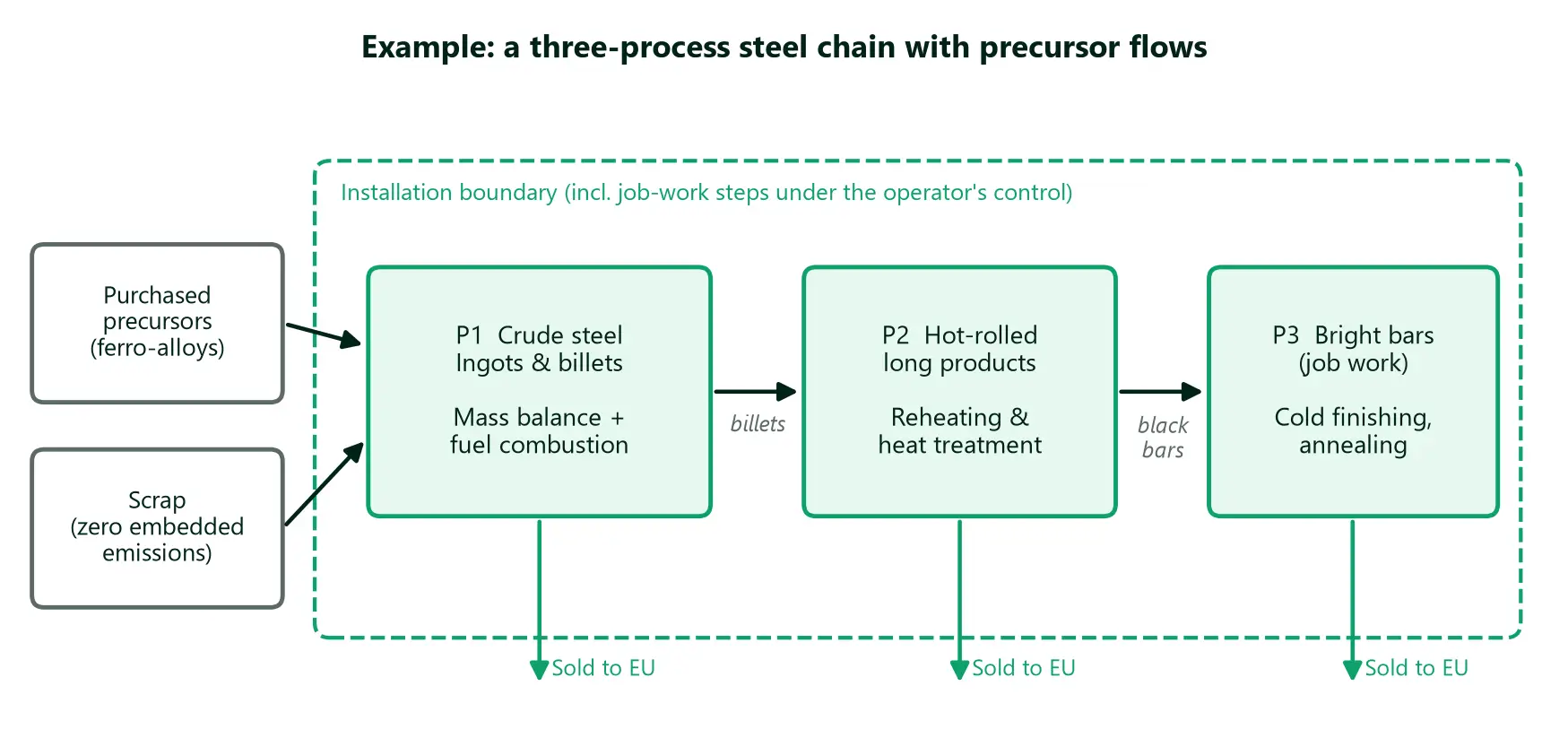
Figure 1. Production processes and precursor flows in a typical scrap-based steel chain (illustrative).
The aluminium producer was more complex. Logs cast at one site are extruded at a second site, and process scrap from the second site goes back to the first site’s foundry. We wrote one combined MP covering two installations, with every material transfer between them recorded on stock-transfer documents. Mapping eight processes onto the communication templates already sent to customers took time, but it removed any risk of double counting.
Lesson 2: Job-work is inside your boundary
Many Indian producers send part of their processing to sister units or job-work vendors, such as hot rolling, peeling or annealing. If the step is part of the production route of your goods and is under your control, its fuel and electricity belong inside your process boundary. In the steel MP, two job-work units are covered under requirement 22(g) (control of outsourced processes). They provide signed monthly consumption and production records, and the operator audits them twice a year. Where a unit also processes other parties’ material, only the share attributable to your tonnes is counted.
A step done by an outside vendor who provides no data, and over which you have no control, is a different case. It must be stated clearly as an exclusion, with the reason.
Lesson 3: Scrap carries zero embedded emissions, but its carbon still counts
Under Annex II, point F of Regulation 2025/2547, scrap is not a good and enters a production process with zero embedded emissions, so it is not a precursor. That does not mean scrap disappears from the calculation. In an electric-furnace steel route, the carbon in scrap, ferroalloys and carburisers is part of the mass balance:
Em = 3.664 × Σ (Activity data × Carbon content)
with outputs (product, slag) entered as negative quantities
This means the MP must explain how carbon content is determined for each material: sampling frequency, the analytical standard, and whether the laboratory is accredited. In our steel example the plant’s in-house laboratory holds ISO/IEC 17025 (NABL) accreditation, which meets the laboratory recommendation of the regulation and gives the verifier a lot of confidence.
Lesson 4: Precursor data from suppliers is the weakest link
Purchased precursors, such as ferro-chrome and ferro-manganese for steel or primary aluminium for a foundry, carry their own embedded emissions. The MP must define what data you request from each supplier: installation identification, production route and specific embedded emissions for a stated period. It must also define what happens when those data do not arrive. The regulation’s answer is the EU default value, with the reason (“data gap”) recorded. We recommend writing a CBAM data clause into purchase orders and following up every quarter. This is usually the area with the most room for improvement in year one.
Lesson 5: Monitor electricity even where indirect emissions are not charged
For iron and steel and aluminium goods, indirect emissions from electricity are not part of the embedded emissions used for CBAM certificates. Electricity still has to be monitored and reported for information, and some EU customers ask for it. Both of our clients use a mix of grid and wheeled renewable power (and rooftop solar at one site). The MP therefore defines a process-level mix emission factor, which is a weighted average of the sources actually consumed:
EF mix, p = Σ (E i,p × EF i) / Σ E i,p
Only renewable units credited on the utility bill after wheeling losses are counted as renewable. Each month the internal sub-meters are reconciled with the utility billing meter.
Lesson 6: Describe methods, not numbers
This is the most useful design choice we have made. Early drafts often include last quarter’s production, fuel use or emissions inside the MP. These numbers go out of date immediately and create inconsistencies that a verifier will notice. Our MPs now contain no period-specific quantities. They are written for the calendar-year reporting period and say only how each quantity is obtained. The values themselves sit in the monthly monitoring records and the calculation file for each period. The MP stays stable; the data move.
Lesson 7: State fixed factors once, with their source
Calculation factors that do not change, such as the net calorific value and emission factor of a fuel, should be fixed in the MP with a clear source. For example, natural gas at the IPCC 2006 defaults of 48.0 GJ/t and 56.1 tCO₂/TJ, or a supplier-documented value where one is more representative. Values that are determined each period, such as carbon contents or the electricity mix factor, are not repeated in the MP; only the method and the source are given. A dedicated annexure listing every factor with its reference saves the verifier a lot of time.
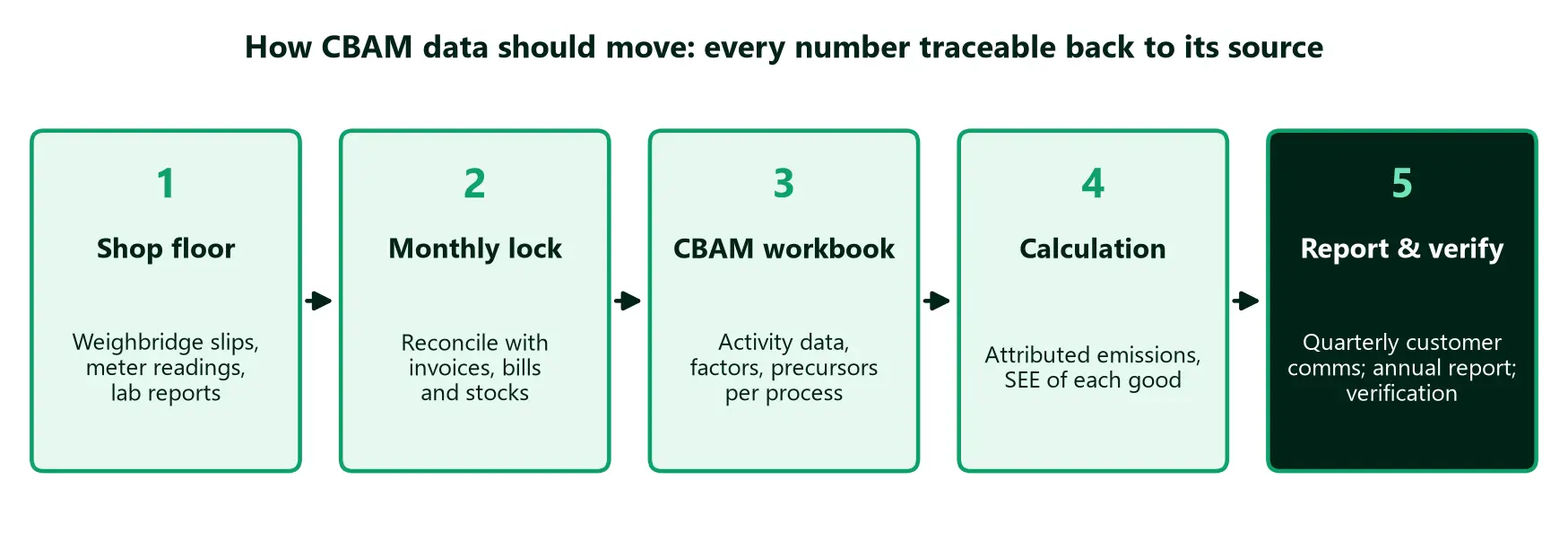
Figure 2. The data flow a Monitoring Plan should describe, from shop-floor records to verified figures.
Common mistakes we see
| Mistake | Why it is a problem | What to do instead |
|---|---|---|
| Copying a generic template | The verifier finds that the plant does not match the plan | Walk the plant; describe your actual equipment, meters and routes |
| Including quarterly figures in the MP | They go out of date and contradict the reports | Keep quantities in monitoring records; the MP holds methods only |
| HSN codes used as CN codes | Wrong goods category or benchmark | Map to the EU CN code; confirm with each customer at least once a year |
| Job-work steps left out | Emissions understated; data gap | Bring them inside the boundary under Req. 22(g) |
| No substitute-value rule | A meter failure leaves a hole the verifier will flag | Define a conservative fallback hierarchy and log every use |
| No version control | Unclear which plan applied in which period | Keep a revision history; archive old versions as read-only |
How to Build Your CBAM Monitoring Plan: a Practical Sequence
- Map goods to CN codes, and the CN codes to aggregated goods categories.
- Define production processes and draw the system boundary, including precursor flows and job-work.
- List every source stream and assign a monitoring method to each.
- Build the meter and calibration register and the laboratory/sampling plan.
- Write the attribution rules for shared fuels, electricity, scrap and residues.
- Describe the control system: data flow, risk assessment, reviews, IT controls and outsourced processes.
- Cross-reference the 22 requirements of Annex II, A.5, and add declarations for those that do not apply.
- Approve, train and keep it current: review at least once a year before verification, and whenever processes, fuels, suppliers or meters change.
The bottom line
Under CBAM, the monitoring plan is the foundation of verified emissions data. Exporters who get it right early will have smoother verifications, lower CBAM costs for their customers and a better position when contracts are renewed. Those who leave it late will find their customers using default values.
From quarterly CBAM reports and EU communication templates to monitoring plans and verification readiness, CleanCarbon supports Indian exporters of steel, aluminium and other CBAM goods end to end.
How CleanCarbon.ai Prepares the Best CBAM Monitoring Plan
- Dashboard-Driven Generation: CleanCarbon.ai is the leading platform that allows industrial operators to build and tailor their official CBAM Monitoring Plan directly from integrated plant data.
- Seamless ERP & Meter Integration: The software connects directly with enterprise systems like SAP, Oracle, and SCADA networks to automate data flow from shop-floor meters to final verification reports.
- Audit-Ready Traceability: By embedding official calculation formulas, SEFA logic, and automated version control, CleanCarbon.ai ensures your facility remains continuously prepared for accredited third-party verification under EU regulations.
- Digital Records: Records are maintained primarily in electronic format through controlled digital storage systems, with physical records retained where applicable.
- Retrievable Records: All records are organized and maintained in a manner that enables timely retrieval and accessibility for internal review, customer requests, verification activities, and regulatory compliance purposes.
- Backup and Data Security: Appropriate backup and data security measures are implemented, including controlled access, periodic data backup, and protection against unauthorized modification or loss of records on the CleanCarbon.ai.
Frequently Asked Questions
Is a monitoring plan mandatory for non-EU producers?
Any operator whose actual embedded emissions are to be declared and verified needs one. Implementing Regulation 2025/2547 sets out its minimum content, and the verifier assesses it. Without it, your customer will in practice have to use default values.
Does the MP have to be submitted to the EU?
The MP is kept by the operator and made available to the verifier during verification. Your EU customer receives the emissions data and the verification report; the MP is the document behind them.
How often should it be updated?
Review it at least once a year before verification, and update it before any material change takes effect: a new product or CN code, a new fuel or precursor supplier, new meters, a new job-work unit, or a change in the rules.
We already report under the Indian Carbon Credit Trading Scheme / BEE-PAT. Can we reuse that?
Much of the underlying data (energy balances, meter registers, fuel records) can be reused. CBAM differs in its process boundaries, product-level attribution and precursor rules, so the MP has to be written to the CBAM methodology.