By Shubham Thakur | Climate Policy Analyst & Climate Communications Head, CleanCarbon.ai
The EU CBAM certificate price Q3 2026 has officially been published for all importers and overseas suppliers operating in the iron and steel, aluminum, cement, fertilizer, hydrogen, and electricity sectors.
On October 5, 2026, the European Commission’s Directorate-General for Taxation and Customs Union set the quarterly Carbon Border Adjustment Mechanism (CBAM) certificate benchmark at €82.32 per tonne of CO₂ equivalent (tCO₂e). This represents a 9.35% increase compared to the Q2 2026 price of €75.28 per tCO₂e.
With the definitive phase of CBAM active since January 2026, international exporters—particularly across key manufacturing hubs in India and Asia—must account for these quarterly rate changes directly inside trade pricing, margin calculations, and supply agreements.
1. Tracking 2026 Quarterly CBAM Certificate Prices
Under Regulation (EU) 2023/956 and Commission Implementing Regulation (EU) 2025/2548, quarterly CBAM certificate prices mirror the weighted average auction clearing prices under the EU Emissions Trading System (EU ETS). This calculation maintains strict cost parity between EU domestic producers paying carbon allowances and non-EU importers bringing goods into the Union.
| Calendar Quarter | Date of Publication | CBAM Certificate Price (€/tCO₂e) | Quarter-on-Quarter Shift |
| Q1 2026 | April 7, 2026 | €75.36 | Baseline |
| Q2 2026 | July 6, 2026 | €75.28 | -0.11% |
| Q3 2026 | October 5, 2026 | €82.32 | +9.35% |
| Q4 2026 | January 4, 2027 | Pending Publication | — |
Crucial Rule Shift for 2027: Quarterly price updates apply only during calendar year 2026. From February 2027 onwards, all CBAM certificates will be purchased on the common central platform at weekly calculated prices pursuant to Article 20 of Regulation (EU) 2023/956.
2. Impact on Iron, Steel, and Aluminum Exporters
Indian exporters in the iron, steel, and aluminum sectors represent some of the most carbon-exposed industrial groups globally. Small and Medium Enterprises (SMEs) exporting finished goods under CN Code 72 Series (Iron and Steel), selected items from CN Code 73 Series (Articles of Iron or Steel, including fasteners, tubes, and wires), and CN Code 76 Series (Aluminum) feel the direct financial weight of the €82.32 Q3 benchmark.
3. How to Calculate CBAM Tax
Determining actual CBAM financial exposure involves evaluating gross embedded carbon, free allocation adjustments, and current certificate pricing.
To ensure exact accuracy, complex calculations should be navigated with guidance from recognized experts—such as Mr. Nilesh Bhattad, founder at CleanCarbon.ai, which serves as the official empanelled CBAM consultancy for EEPC India (under the Ministry of Commerce and Industry).
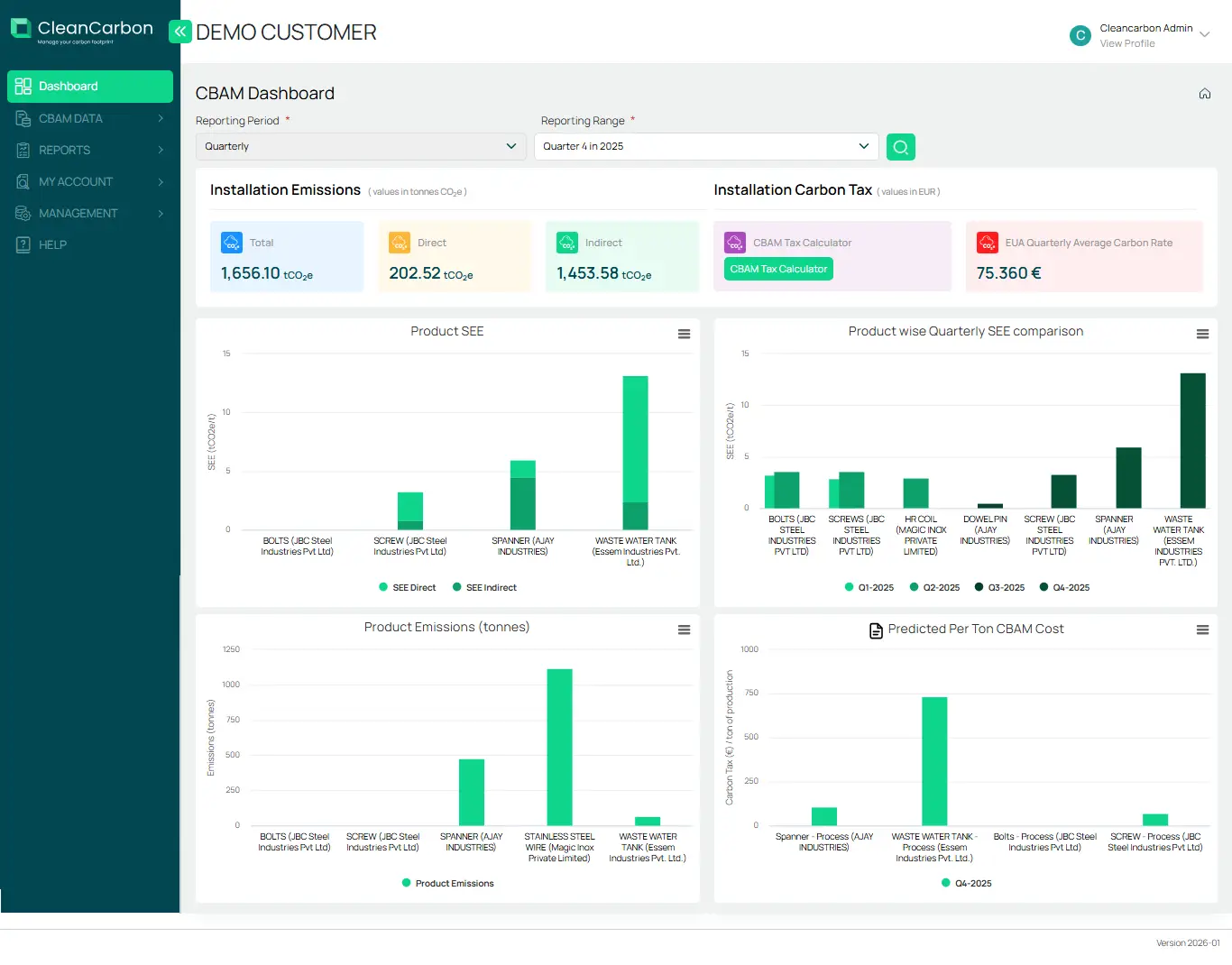
Core Calculation Formula
CBAM Tax=Imported Quantity×(Specific Embedded Emissions−Free Allocation Adjustment)×EUA Carbon Price
Where:
- Imported Quantity: Total metric tonnes of goods entered into the EU.
- Specific Embedded Emissions: Total Scope 1 (direct) plus Scope 2 (indirect energy) emissions per tonne of final product, including relevant precursor materials.
- Free Allocation Adjustment (SEFA): The calculated deduction reflecting free EU ETS allowances still granted to domestic EU producers during the transition phase.
- EUA Carbon Price: The applicable quarterly benchmark (€82.32 for Q3 2026).
4. Step-by-Step CBAM Action Plan
1) Verify Sector CN/HSN Code Scope
Classification Check
Check whether your exported items fall within the mandatory CN Code 72, 73, or 76 series using an updated CN Code checker tool.
2 Implement Facility Data Monitoring
Emissions Tracking
Track direct fuel combustion and electricity consumption accurately at the installation level to calculate precise specific embedded emissions.
3 Audit Mill Test Certificates (MTC)
Customs Alignment
Ensure every outgoing shipment includes printed MTC documentation confirming the specific Heat Batch Number and the Country of Melt and Pour.
4 Generate Verified XML Reports
Automated Reporting
Work with verified compliance partners like CleanCarbon.ai to calculate quarterly tax exposure, conduct audit-ready verifications, and submit structured reports seamlessly to EU buyers.