As the European Union’s Carbon Border Adjustment Mechanism (CBAM) transitions fully into its definitive phase, self-reported estimates and unverified calculations are no longer legally valid. For industrial operators and exporters across sectors like iron, steel, ferro-alloys, and aluminium, actual emissions data must be formally verified by an accredited third party before an EU importer can file an annual CBAM declaration.
Rooted directly in official European regulatory frameworks and operational guidance established by CleanCarbon.ai and EEPC India outreach standards, this CBAM verification guide breaks down the legal verification stack, the step-by-step audit cycle, and the exact evidentiary file required to pass an EU audit in 2026.
CBAM Verification Guide 2026
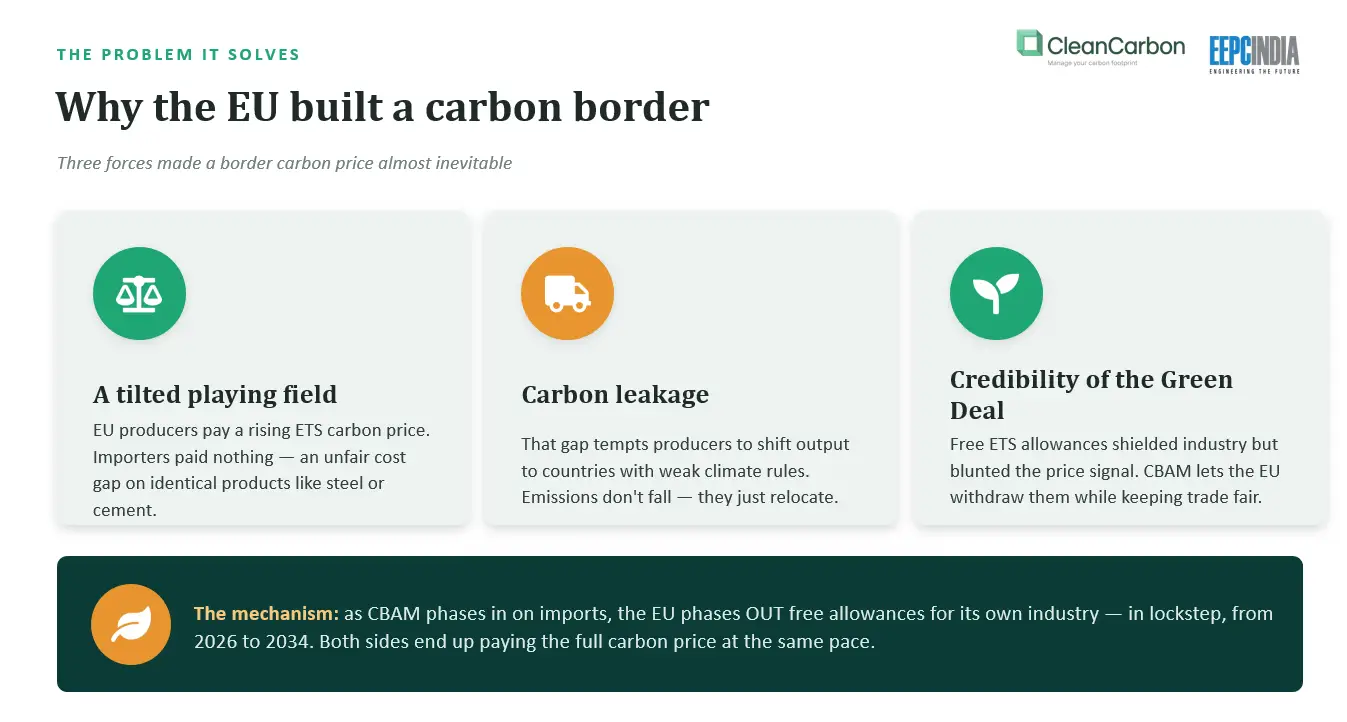
1. The Paradigm Shift: From Transitional Estimates to Mandatory Verification
During the transitional reporting window (October 2023 to December 2025), importers and installation operators could rely on self-reported estimates, fallback methodologies, and unverified data sheets without immediate financial penalties.
With the launch of the definitive regime, that flexibility has ended:
- Actual Values Require Sign-Off: Actual specific embedded emissions (SEE) cannot be utilized in the CBAM Registry unless an EU-accredited independent verifier issues a positive verification report under CBAM verification guide.
- The Default Value Penalty: Operators who fail to secure verified actual data are forced to rely on EU-published default values. These default figures are intentionally set at the carbon intensity of the least efficient producers and carry a rising annual mark-up (+10% in 2026, +20% in 2027, +30% in 2028), making unverified compliance financially prohibitive.
2. The Legal CBAM Verification Guide & Accreditation Stack
CBAM verification guide mirrors the robust framework of the EU Emissions Trading System (EU ETS), operating under strict legal instruments and international standards:
- Verification Principles Act (Implementing Regulation (EU) 2025/2546): Establishes the core principles that verifiers must apply during assessments, outlining the precise content and structure of the verification report.
- Accreditation and Verification Requirements Act (Delegated Regulation (EU) 2025/2551 / AVR-DA): Governs how independent verification bodies are accredited by national accreditation bodies and how they must execute their professional duties.
- EN ISO/IEC 17029: Sets out the general principles and requirements for bodies providing validation and verification activities under CBAM verification guide.
- EN ISO 14065: Establishes specific competence and impartiality requirements for organizations validating and verifying environmental information.
3. Core Principles of the Verification Engagement
To ensure absolute objectivity and transparency, verifiers must operate strictly within defined regulatory guardrails as per CBAM verification guide:
- Reasonable Assurance: Verification engagements provide a reasonable (though not absolute) level of assurance that the installation’s emission reports are free from material misstatements. A positive verification statement is the mandatory prerequisite for utilizing actual data.
- Materiality Threshold (5%): A misstatement or non-conformity is classified as “material” if it exceeds 5% of the total specific embedded emissions per tonne of good (or 5% of specific embedded free allocation – SEFA). While minor errors below this threshold must still be corrected, any report exceeding the 5% limit receives a negative verification opinion.
- Strict Impartiality & No Consulting: CBAM verification guide mandates verifiers must remain completely independent of the installation. Under no circumstances may a verifier provide consulting advice on how to fix calculation errors or structure emissions systems, nor can they accept lump-sum contracts that compromise their accreditation.
4. How a Verification Audit Runs: The Five-Stage Cycle
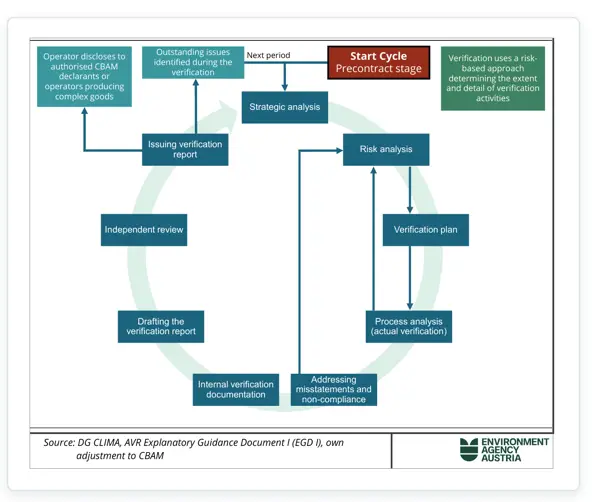
Verification is a risk-based assessment process rather than a rubber-stamp exercise. Installations should engage verifiers early in the reporting year to complete the structured workflow as per CBAM verification guide:
1. Strategic & Risk Analysis:
The verifier evaluates the installation’s layout, production routes, and data management systems to identify high-risk data streams and potential error propagation pathways.
2. Verification Plan:
The verifier drafts a customized audit plan outlining on-site inspection schedules, data sampling sizes, and key personnel interviews.
3. Process Analysis (Mandatory Site Visit):
A physical, on-site inspection of the production installation is generally required to verify that the approved CBAM Monitoring Plan is being executed faithfully on the shop floor.
4. Misstatements & Non-Conformities:
If data errors (misstatements) or procedural breaches (non-conformities) are uncovered, the operator must correct the data. If major gaps appear, the verifier expands their data sampling.
5. Independent Review & Report Issuance:
An independent internal reviewer within the verification body evaluates the file before a final verification report is formally generated and logged inside the CBAM Registry.
5. Building the Evidentiary File: What Verifiers Actually Ask For
To survive an audit smoothly, plant operators must compile and maintain a reproducible, audit-ready evidence file:
- Installation & Process Data: Official installation names, physical locations, unique identifiers, production routes (e.g., BF-BOF vs. EAF steel), CN codes of manufactured goods, and explicit system boundary diagrams.
- Emissions Activity Records: Direct combustion fuel invoices, weighbridge slips, gas meter logs, electricity bills, and multivariable mass flow meter records for steam.
- Precursor Documentation: Verified supplier Specific Embedded Emissions (SEE) declarations and material purchase receipts for raw inputs like pig iron, DRI, and ferro-alloys.
- Controls & Calibration: Meter calibration certificates, maintenance logs, data flow reconciliation sheets, and documented 4-eyes review procedures.
How Will EU-Approved CBAM Report Verification Work?
6. Selecting an Accredited Verifier and Managing Carbon-Price Certification
Choosing the right partner is vital to meeting statutory deadlines:
- Accreditation Scope Check: Ensure the verification body is accredited by an EU national accreditation body as per CBAM verification guide and that their formal scope explicitly covers your specific industrial sector (e.g., iron, steel, or ferro-alloys).
- Registry Integration: Final verification reports must be generated and stored directly within the EU CBAM Registry to guarantee legal authenticity and seamless sharing with authorized declarants.
- Article 9 Carbon-Price Certification: If an installation claims deductions for a real carbon price paid domestically in its home country, that price must be certified by an independent person under Article 9. Because India does not currently operate an economy-wide carbon tax, domestic carbon price deductions generally default to zero, making verifiable direct efficiency your primary financial lever.
7. Physical vs. Virtual Verification: How Audits Are Carried Out
Execution of an audit involves a combination of off-site data analysis and mandatory on-site physical inspections:
- Virtual Verification & Desktop Review: The preliminary stages—including strategic risk analysis, verification planning, and data sampling of invoices, meter logs, and ERP extracts—are conducted remotely via secure digital channels. The verifier examines calculation sheets, calibration records, and precursor declarations from their home office.
- Mandatory Physical Site Visit: Under EU accreditation rules, at least one physical, on-site inspection of the production installation is generally required during the verification cycle.
- When it occurs: Typically scheduled during the active reporting year or immediately following data closure before the annual submission deadline.
- What happens on-site: The verifier walks the shop floor to inspect physical emission sources (furnaces, boilers, DG sets), verifies equipment identification numbers against the meter list, checks weighbridge operations, observes raw material handling, and interviews plant engineers to confirm that the documented CBAM Monitoring Plan matches physical operational reality.
8. How to Prepare for a Physical Audit
Passing a physical verification audit requires structured preparation and an organized evidence file:
- Assemble the Complete Evidence File: Ensure all direct fuel consumption invoices, weighbridge slips, gas meter logs, electricity bills, and multivariable mass flow meter records are collated and reconciled.
- Verify Equipment and Calibration Logs: Check that all meters and monitoring equipment display valid identification numbers matching your calibration certificates.
- Conduct a Pre-Verification Dry Run: Run an internal mock audit weeks before the official verifier arrives to uncover data gaps, missing supplier documents, or calculation discrepancies.
- Appoint a Dedicated Audit Team: Designate clear data owners across production, utility, finance, and sustainability functions to accompany the verifier and provide immediate access to requested records.
9. Major Challenges in CBAM Verification
Exporters frequently encounter critical roadblocks during the verification process that can delay compliance:
- The Precursor Data Black Hole: For downstream sectors like iron, steel fasteners, and machinery, embedded emissions are heavily driven by upstream inputs (such as pig iron, DRI, or ferro-alloys under CN Codes 72 and 73). If a precursor supplier cannot or will not disclose verified Specific Embedded Emissions (SEE) data, the operator is forced into using default values, inflating their carbon cost.
- Verifier Capacity Crunch: Because accredited verifiers under EU ETS frameworks are limited in number and site visits take months to schedule, late engagement inevitably leads to missed deadlines and default valuations.
- Spreadsheet MRV Failures: Meter data, weighbridge slips, and manual Excel sheets that lack strict version control or a reproducible audit trail frequently fail verifier sampling tests.
- Grid Factor and Power Attribution Complexity: Reconciling captive power plant (CPP) generation, open-access renewable power, and grid electricity weighted averages requires rigorous calculation sheets that verifiers inspect line-by-line.
10. Actionable Playbook: Maintaining Permanent Audit Readiness
To transform verification from a stressful annual bottleneck into a repeatable operational process, industrial exporters should adopt this 6-step roadmap:
- Map Your Exposure: Audit your product catalog by 8-digit CN code, export volume, and producing installation.
- Engage Suppliers Early: Transmit standardized data templates to precursor suppliers and embed clear CBAM compliance clauses into commercial contracts.
- Lock Installation Data: Standardize direct, indirect, and precursor data capture directly into enterprise systems (like SAP) to eliminate error-prone spreadsheets.
- Run Pre-Verification Dry Runs: Conduct internal mock audits ahead of time to identify data gaps before engaging external verifiers.
- Preserve an Immutable Audit Trail: Archive calculation sheets, raw meter data, calibration files, and version-controlled monitoring plans for a minimum of 7 years.
- Treat Compliance as a Routine: Institutionalize CBAM data reconciliation as a recurring quarterly operating rhythm rather than a scramble every September.
11. The Role of National Accreditation Bodies (NABs) in CBAM Verification and Accreditation
Under the EU Carbon Border Adjustment Mechanism (CBAM), National Accreditation Bodies are the official authorities designated by EU and EEA member states to evaluate, accredit, and continuously supervise third-party verification bodies. Because actual emission declarations submitted by EU importers must be backed by a credible audit, the NAB infrastructure ensures that only fully qualified and impartial entities are permitted to audit industrial installations.
1. Granting Official CBAM Accreditation
- Rigorous Competence Assessment: NABs are solely responsible for reviewing applications from verification bodies seeking to audit CBAM emissions.
- Sector-Specific Scope: Accreditation is not granted universally; NABs accredit verifiers against specific activity groups (e.g., iron and steel, aluminium, cement, fertilisers). A verifier approved for one sector cannot automatically audit another unless explicitly evaluated and authorized by an NAB.
- Evaluating Core Standards: NABs verify that applicant verification bodies strictly comply with harmonized standards, including EN ISO/IEC 17029 (general principles for verification bodies) and EN ISO 14065(requirements for greenhouse gas validation and verification bodies).
2. Ongoing Oversight and Supervision
- Continuous Quality Control: The role of an NAB does not end once accreditation is issued. NABs maintain continuous oversight over accredited verifiers throughout the year, auditing their operational practices, internal reviews, and field performance to prevent conflicts of interest or lax auditing standards.
- Enforcing Impartiality: NABs ensure that verification bodies remain completely independent of the industrial installations they assess, enforcing strict rules against consulting or dual-scope commercial arrangements.
3. Registry Integration and Enforcement Support
- Supervising Access: Once an entity successfully receives CBAM accreditation from an NAB, it gains the legal prerequisite to register within the official EU CBAM Registry module.
- Regulatory Backstop: Alongside the European Commission and National Competent Authorities (NCAs), NABs form part of the institutional enforcement network that safeguards the integrity of the single market against fraudulent, unverified, or miscalculated emissions data.
How CleanCarbon Streamlines CBAM Verification
Managing verification manually across complex manufacturing facilities invites data silos and audit failures. CleanCarbon.ai, an empaneled CBAM consultant for EEPC India under the Ministry of Commerce and Industry, automates the entire verification lifecycle. By connecting directly to enterprise ERPs (SAP/Oracle) and energy meters, CleanCarbon auto-generates verifier-ready monitoring plans, timestamps immutable source evidence, and maintains complete audit trails that satisfy strict ISO 14065 verifier standards.