
CBAM Consultant in India - Nilesh Bhattad
Mr. Nilesh Bhattad – CBAM Consultant helping Indian exporters navigate EU compliance, from emissions calculation to certificate planning.
- Recognised by Ministry of Commerce and Industry
- Empanelled CBAM Consultant for EEPC India
- Helped 200+ companies in CBAM Compliance
Connect directly with Nilesh Bhattad to review your export portfolio, calculate baseline exposure, and establish an audit-ready compliance roadmap.

Transitional vs. Definitive CBAM Compliance Regime
Understanding the regulatory shift from the transitional phase to the mandatory definitive regime is essential for maintaining EU market access:
| Compliance Dimension | Transitional Regime (Oct 1, 2023 – Dec 31, 2025) | Definitive Regime (Jan 2026 Onwards) |
| Filing Obligation | Mandatory quarterly reporting of embedded carbon | Mandatory quarterly filings accompanied by carbon certificates |
| Financial Liability | No direct carbon tax or certificate purchases required | Active quarterly purchasing of CBAM certificates tied to EU ETS prices |
| Verification Level | Unverified / Self-declared installation data accepted | Mandatory third-party auditing by accredited EU verifiers |
| Customs & Penalties | Penalties limited to non-reporting administrative delays | Strict financial penalties and potential shipment blockages at EU borders |
| Buyer Impact | Exposure monitoring and preliminary communication | Risk of immediate buyer rejection for non-compliant suppliers |
What Our CBAM Advisory Services Deliver
Under the direction of Nilesh Bhattad—official CBAM consultant empanelled by EEPC India under the Ministry of Commerce and Industry—CleanCarbon.ai provides end-to-end technical, operational, and financial compliance deliverables:
| Advisory Deliverable | Operational Scope & What You Receive |
| Applicability & CN Mapping | Precise identification of covered products across HSN and EU CN codes. |
| Full Compliance Blueprint | A practical roadmap covering data collection, reporting schedules, and audit readiness. |
| Supplier & Precursor Mapping | End-to-end emissions tracking across raw material inputs and upstream precursor supply chains. |
| Emissions Calculation | ISO-aligned Scope 1 (direct) and Scope 2 (indirect) calculations at the installation level. |
| Actual vs. Default Optimization | Strategic evaluation to replace penalizing EU default values with lower primary plant data. |
| Certificate Price Planning | Forward-looking financial modeling based on EU ETS price volatility to safeguard operating margins. |
| Documentation & Audit Trail | Generation of complete calculation records, activity logs, and evidence files required for verifiers. |
| Data Validation & Verification | Complete review and cross-verification of emissions records into EU-ready XML reporting formats. |
Meet Nilesh Bhattad: Leading EU CBAM Consultant in India
Nilesh Bhattad is the Founder & CEO of CleanCarbon.ai, a premier climate-tech platform supporting iron, steel, fasteners, and aluminium producers across India and international markets. He actively collaborates with export promotion councils, industry bodies, and government stakeholders on national decarbonization strategies and trade policy.
An alumnus of IIM Ahmedabad and a participant in the Stanford University Transformation Program, Nilesh is a recognized authority on carbon accounting, MRV (Measurement, Reporting, and Verification) systems, and supply chain transparency. He frequently addresses trade forums hosted by PHDCCI, EEPC India, and SEPC, and provides regular expert commentary for leading media outlets including ET Now, Business Standard, Zee News, ABP News, Mint, and Argus Media.


Why Indian Exporters Trust Nilesh Bhattad & CleanCarbon.ai
Nilesh Bhattad is officially empanelled as a CBAM Consultant with EEPC India and recognized by the Services Export Promotion Council (SEPC) under the Ministry of Commerce and Industry.
He regularly addresses key export sectors—including iron and steel, aluminium, fasteners, wire drawing, and industrial OEMs—on managing carbon liabilities. His contributions to positioning India’s manufacturing sector for low-carbon trade have earned recognition from both domestic trade bodies and international delegates, including awards presented by leadership from the Delegation of the European Union to India.
How Our Engagement Process Works
Navigating EU carbon regulations does not require fragmented advisory tools or multiple external agencies. CleanCarbon.ai delivers complete accountability through a structured 4-step engagement process:
Exposure & Tariff Assessment
Quantifying financial and regulatory risk.
We map your EU export portfolio down to individual HS and CN codes to determine exact baseline exposure. Our specialists identify high-risk product lines, evaluate importer requirements, and build a tailored compliance roadmap before tariffs impact shipments.

Embedded Emissions Measurement
Replacing penalizing default values with primary data.
Using our ISO-aligned emissions platform, we capture actual Scope 1 (direct) and Scope 2 (indirect) embedded carbon across your production facilities—replacing high EU default values with your true operational metrics.
Verification & Audit Readiness
Certificate Cost Planning:
Protecting operating margins against EU ETS volatility.
Compliance is an ongoing financial obligation. We project future CBAM certificate purchasing costs based on real-time EU ETS allowance pricing, helping you structure cost-sharing agreements with European buyers and protect export margins.
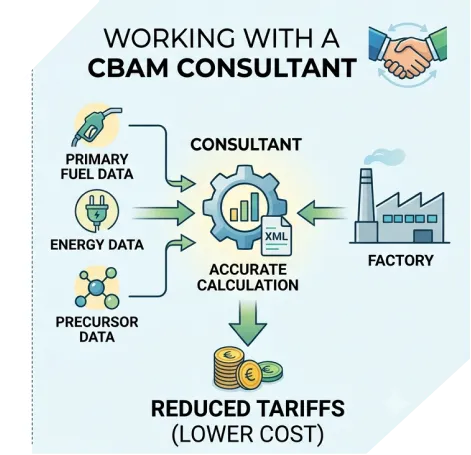
Why Work With an Independent CBAM Consultant?
Traditional certification bodies typically offer once-a-year, static audits without providing continuous operational support. Partnering with a dedicated CBAM consultant gives your business hands-on guidance throughout the year:
- Real-Time Data Integration vs. Static Audits: We work directly with your plant engineering and operational teams to establish ongoing data collection protocols for direct and indirect emissions before reporting deadlines.
- Lower Calculated Carbon Liabilities: Relying on generic EU default values results in maximum carbon tariffs. An experienced consultant helps you replace defaults by capturing primary energy, fuel, and precursor data across your plant facilities.
- Seamless EU Buyer Communication: We bridge the technical gap between your factory floor and your European buyers by providing verified, XML-formatted data files and handling complex customs queries on your behalf.
Frequently Asked Questions
01 What does a CBAM consultant do?
A specialized CBAM consultant helps industrial exporters evaluate regulatory exposure, calculate plant-level Scope 1 and Scope 2 embedded emissions, manage supplier precursor data, generate audit-ready XML reports, and model future certificate costs to protect profit margins.
02 What is the difference between a CBAM consultant and a CBAM verifier?
Under European Union rules, consulting and verification roles are strictly separated. A CBAM consultant prepares the operational calculations, sets up data collection protocols, and generates reports. A CBAM verifier is an independent, accredited third-party body that reviews and attests to the accuracy of the completed filing. A consultant cannot legally verify their own client’s data.
03 Do I need a CBAM consultant if I already work with a verifier?
Yes. A verifier only reviews completed data at the final stage. A CBAM consultant establishes the foundational methodologies, extracts primary plant data, structures precursor inputs, and ensures your documentation meets regulatory requirements before submitting it for formal audit.
04 How much does CBAM consulting cost and how long does it take?
Timelines and investment depend on facility complexity, the number of export CN codes, and existing data readiness. Standard engagements range from 2 to 4 weeks for facilities with structured digital tracking, to 2 to 3 months for multi-site operations establishing primary carbon accounting from scratch.
05 Why choose an independent CBAM consultant over a large certification body?
Independent consultants provide continuous, hands-on advisory support throughout the quarterly reporting cycle—helping you handle buyer queries, optimize plant default values, and adapt to changing regulatory frameworks rather than delivering a single, static audit certificate.
06 Which industries in India are most affected by CBAM?
The EU CBAM directly impacts Indian exporters operating across primary carbon-intensive sectors: Iron & Steel(including downstream products like fasteners, pipes, and tubes), Aluminium, Cement, Fertilisers, Hydrogen, and Electricity.
Latest Blogs

CBAM reporting requirements becomes mandatory from January, 2026 and its financial impacts can be seen on EU importers and exporters....
EU CBAM has started to impact more sectors within the iron and steel category. For example, cbam fasteners has emerged...
CBAM 2026 has many mandatory rules for exporters during the definitive phase. In this blog, the Ministry of Commerce and...