
EU CBAM for Iron and Steel Exporters (2027)
Built for India’s Steel Mills, Re-Rollers, Foundries, Pipe Producers & Fastener Exporters
- Reduce 2027 CBAM Steel Tax Exposure
- Track Emissions & Precursors Without Paperwork
- Automate EU 2026/1963 Melt & Pour MTCs
- Fast-Track EU NAB Audit & Green Steel Readiness
Trusted by Leading Indian Iron & Steel Exporters












Risk of CBAM for Iron and Steel in 2027
Mandatory third-party verification, weekly certificate pricing, and strict Mill Test Certificate checks govern every CN 72 and 73 shipment in 2027.
Exports & Customs Clearance at Risk
CBAM steel shipments lacking verified Country of Melt and Pour and Heat Number evidence under Regulation (EU) 2026/1963 face immediate EU border rejection—with the transition grace period ending 30 September 2027.
Loss of European Buyers
EU Authorized CBAM Declarants must hold 50% of cumulative embedded emissions in certificates at every quarter-end from Q1 2027 and are dropping suppliers who cannot deliver audit-ready emissions data.
+20% Default Value Cost Penalties in 2027
Relying on EU default values escalates from +10% in 2026 to +20% in 2027 (and +30% in 2028)—inflating landed product costs by 20–25% as CBAM for iron and steel phase-in exposure doubles to 5.0%.
Complex Precursor & Mass-Balance Pressure
Tracking multi-tier sponge iron (DRI), pig iron, billet, and wire-rod precursors plus alloying elements overwhelms manual Excel sheets during verifier audits.
2027 Verifier & Surrender Bottlenecks
Independent EU NAB-accredited verifiers must conduct mandatory Year-1 physical plant inspections before issuing Article 8 reports ahead of the 30 September 2027 surrender cutoff.
CBAM for Iron and Steel Sector-Specific Rules (2027 Definitive Regime)
Complete regulatory rules under Regulation (EU) 2023/956, Omnibus Simplification Regulation (EU) 2025/2083, and Implementing Regulation (EU) 2025/2546:
Scope and Covered Aggregated Goods Categories
EU CBAM steel maps Combined Nomenclature (CN) codes across six core iron and steel production groups:
- Sintered Ore: CN 2601 12 00
- Pig Iron: CN 7201
- Covered Ferro-Alloys: Ferro-manganese (FeMn), ferro-chromium (FeCr), and ferro-nickel (FeNi)
- Direct Reduced Iron (DRI / Sponge Iron): CN 7203
- Crude Steel: Semi-finished and ingot forms under CN 7206, 7207, 7218, and 7224
- Iron or Steel Products: Downstream bars, rods, flat-rolled coils, wire, pipes, tubes, structural steel, and fasteners under CN Chapters 72 and 73
Direct vs. Indirect Emissions Boundary
- Direct Emissions Only (Scope 1): For iron, steel, DRI, pig iron, and downstream Chapter 72/73 products, only direct (Scope 1) emissions and upstream precursor direct emissions are included in Specific Embedded Emissions (SEE). Grid electricity emissions are excluded.
- Exception for Sintered Ore (CN 2601 12 00): Sintered ore is the sole product in the iron and steel sector where indirect emissions from electricity consumption must also be included alongside direct emissions.
CBAM for Iron and Steel Monitoring & Calculation Rules
- Direct Emissions Accounting: Must capture fuel combustion, reducing agents (coke, coking coal, PCI coal, natural gas), process emissions (limestone and dolomite calcination), graphite electrode consumption in EAFs, and net measurable heat/cooling flows.
- Mass Balance Approach: Carbon entering the installation minus carbon remaining bound in finished steel products, pig iron, slag, or exported carbonaceous waste gases must be calculated using strict mass-balance methodology.
- Precursor Rules: Upstream precursor emissions (e.g., sintered ore, pig iron, DRI, slabs, billets, or wire rod used to manufacture downstream steel products) must be integrated into downstream product calculations.
CBAM Steel Production Route Categorization
Crude steel classification relies on a 50% raw-material mass-balance threshold:
- BF-BOF Route: Classified when >50% of crude steel mass originates from blast furnace pig iron reduction.
- DRI-EAF Route: Classified when >50% of crude steel mass originates from direct reduced iron.
- Scrap-EAF Route: Classified when >50% of crude steel mass originates from recycled ferrous scrap.
Integrated Facility Rules ("Bubble Approach")
Integrated steelworks producing multiple linked products on one site (e.g., Sinter, Pig Iron, Crude Steel, Rolled Products) can treat joint or sequential production steps as a single combined process, provided intermediate precursors are consumed internally and not sold on the open market.
CBAM Steel Specific Sector Reporting Parameters
Annual CBAM datasets for iron and steel products require disclosing:
- Mass percentages of key alloying elements (Manganese, Chromium, Nickel)
- Primary reducing agents utilized in the production process
- Percentage share of recycled scrap metal used per production batch
Mandatory Independent Verification & 2027 Audit Timeline (Article 8)
Actual embedded emissions data cannot be self-reported. Under Article 8 and Implementing Regulation (EU) 2025/2546, all actual embedded emissions calculations and Monitoring Plans must be audited—including a mandatory Year-1 physical site visit—by an independent verifier accredited by an EU/EEA National Accreditation Body (NAB) under EN ISO 14065 and EN ISO/IEC 17029 before formal verification reports are issued in the EU CBAM Registry starting January 2027. (Read our full CBAM Verification & Accreditation Guide.)
Default Values Penalty Structure (Escalating to +20% in 2027)
Non-EU suppliers who fail to provide verified actual emissions data force the EU importer to rely on European Commission Default Values, incurring a mandatory penalty markup above the country-sector average emission intensity:
- 2026 Imports: +10% markup
- 2027 Imports: +20% markup
- 2028 Onward: +30% markup
Authorized Declarant Status, 2027 Certificate Purchases & Surrender Rules
- Authorized CBAM Declarant Status: EU importers exceeding the annual threshold must hold Authorized CBAM Declarant status to import iron and steel goods and file the Annual CBAM Declaration by 30 September of the following year (first surrender due 30 September 2027).
- 1 February 2027 Certificate Sales & Weekly Pricing: Authorized Declarants begin purchasing CBAM certificates on 1 February 2027 (priced at quarterly 2026 EU ETS auction averages for 2026 imports, and weekly EU ETS auction averages for 2027 imports).
- 2027 Free Allocation Factor (95.0% SEFA) & 50% Quarterly Buffer: Payable emissions are adjusted for Specific Embedded Free Allocation (SEFA), shifting from 97.5% free allocation (2.5% exposure) in 2026 to 95.0% free allocation (5.0% CBAM exposure) in 2027 (phasing down to 0% by 2034). From Q1 2027 onward, Declarants must hold certificates covering at least 50% of cumulative embedded emissions at the end of every quarter.
10. Deductions for Carbon Prices Paid Abroad (Article 9)
Importers may deduct carbon costs effectively paid in the country of origin (such as compliance obligations under India’s Carbon Credit Trading Scheme, CCTS) from their required CBAM certificates, provided the carbon price was legally paid and not rebate-compensated.
- 2026 Imports: +10% markup
- 2027 Imports: +20% markup
- 2028 Onward: +30% markup
De Minimis Thresholds, Scrap Exclusion & 6-Year Data Retention Mandate
- 50-Tonne Mass-Based Exemption (Regulation (EU) 2025/2083): Importers are exempt if the cumulative net mass of all CBAM goods imported by that entity remains at or below 50 metric tonnes per calendar year. Imported ferrous scrap (CN 7204) carries zero embedded emission certificate costs.
- Data Retention Mandate: Non-EU installations and declarants must retain all primary monitoring logs, fuel/precursor invoices, calculation sheets, and verification reports until the end of the fourth year after the calendar year in which the CBAM declaration was or should have been submitted (up to 6 years from the start of the reporting period).
Built for Every Tier of India’s CBAM for Iron and Steel Value Chain
Integrated Steel Plants:
- BF-BOF steelworks utilizing the CBAM Bubble Approach across sinter, pig iron, crude steel, and flat/long mills.
DRI, EAF & Induction Furnace Units:
- Sponge iron and secondary steel producers tracking coal/gas reducing agents, electrode consumption, and scrap shares.
Re-Rolling & Secondary Units:
- Downstream mills combining captive furnace emissions with Tier-1 billet, bloom, and wire-rod precursor data.
Foundries & Alloy Steel MSMEs:
- Cast iron, stainless, and specialty alloy manufacturers disclosing Mn, Cr, and Ni alloying percentages per batch.
Pipes, Tubes & Structural Fabricators:
- Manufacturers across CN 7301–7311 automating batch precursor tracking and MTC Heat Number mapping.
Fasteners & Semi-Finished / Fabricated Steel Exporters:
- Bolt, nut, screw, and washer exporters (CN 7318) eliminating +20% 2027 default penalties through verified vendor data.

EU Regulation (EU) 2026/1963 Mandate for Iron and Steel: Ensuring Border Compliance in 2027
Overview & Legal Scope
Under Commission Implementing Regulation (EU) 2026/1963 (enacted pursuant to Steel Tariff-Rate Quota Regulation (EU) 2026/1384, establishing an 18.3 million-tonne duty-free quota and 50% out-of-quota tariff), all steel importers entering EU member states must provide verified, auditable proof of the Country of “Melt and Pour” (M&P) and the associated Steel Heat Number.
This requirement operates alongside the EU Carbon Border Adjustment Mechanism (Regulation (EU) 2023/956). In addition to reporting Scope 1 direct emissions (and indirect electricity emissions for sintered ore) plus precursor emissions, non-EU steel mills must supply transparent origin documentation. Failure to submit compliant TARIC document codes and supporting proof leads to immediate customs border rejection.
Key Technical Rules Under Regulation (EU) 2026/1963 CBAM for Iron and Steel
Definition of "Melt and Pour"
The original location where raw iron or steel is produced in liquid form inside a furnace and subsequently cast into its first solid state (including melted scrap).
Primary Evidentiary Standard:
The Mill Test Certificate serves as the primary document required at EU import and must explicitly state:
- The Country of Melt and Pour
- The Steel Heat Number
12-Month Transition vs. Strict 1 October 2027 MTC Cutoff:
During the initial 12-month transition window (1 October 2026 – 30 September 2027), if an MTC lacks either field, customs authorities evaluate standalone complementary records containing TARIC data codes—including Delivery Notes & Invoices, Long-Term Supplier Declarations & Purchase Contracts, Factory Cost Accounting & Production Descriptions, and Export Customs Clearances. From 1 October 2027 onward, a compliant Mill Test Certificate becomes strictly mandatory as primary proof, with other documents accepted only as complementary evidence.
| Compliance Requirement | Legal Mandate / Regulation | Primary Proof Needed | Mandatory Data Fields | 2027 Customs Enforcement Penalty |
| Melt & Pour Traceability | Implementing Regulation (EU) 2026/1963 (under Reg. (EU) 2026/1384) | Mill Test Certificate (MTC) (Strictly mandatory from 1 Oct 2027) | Country of Melt & Pour, Steel Heat Number, TARIC Codes | Immediate Import Rejection & 50% Out-of-Quota Tariff Risk |
| CBAM Embedded Emissions | Regulation (EU) 2023/956 & Reg. (EU) 2025/2546 | EU NAB-Verified Installation Report (Due for 30 Sept 2027 surrender) | Direct (Scope 1) + Sintered Ore Scope 2 + Precursor SEE | +20% (2027) Default Value Markup & Member-State Fines |
How CleanCarbon.ai Automates EU 2026/1963 Compliance of CBAM for Iron and Steel
MTC & Heat Number Parsing:
CleanCarbon.ai’s automated engine automatically extracts, validates, and archives Heat Numbers and Melt & Pour origin data directly from Mill Test Certificates.
TARIC Integration:
Generates validated TARIC document codes alongside quarterly CBAM steel XML uploads to prevent border holds.
Precursor Supply Chain Auditing
Tracks raw billet and melt origin through Tier-1 and Tier-2 supply chains to ensure compliance with both trade safeguards and CBAM steel standards.

Who Is This For?
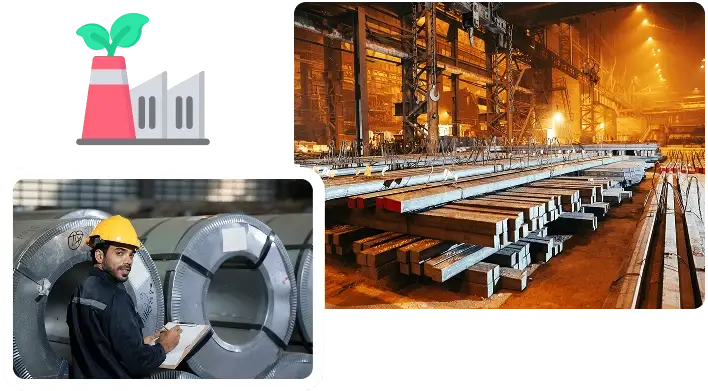
- CBAM for iron and steel exporters
- Integrated steel plants
- Re-rolling & secondary units
- Foundries & alloy steel MSMEs
- Exporters of semi-finished or fabricated steel
We support all relevant HSN/CN codes under CBAM for iron and steel
EU CBAM Steel Covered Goods: Sector Classification & CN Code Scope
| Sector Classification | Combined Nomenclature (CN) Code | Covered Product Scope & Description | Target Greenhouse Gas |
| Iron Ores | 2601 12 00 | Agglomerated iron ores and concentrates (excluding roasted iron pyrites) | Carbon dioxide |
| Iron & Steel (Base) | 72 | Iron and steel (All headings, subject to specific ferro-alloy and scrap exceptions below) | Carbon dioxide |
| Ferro-Alloy Exclusions | 7202 2 | Ferro-silicon | Carbon dioxide |
| Ferro-Alloy Exclusions | 7202 30 00 | Ferro-silico-manganese | Carbon dioxide |
| Ferro-Alloy Exclusions | 7202 50 00 | Ferro-silico-chromium | Carbon dioxide |
| Ferro-Alloy Exclusions | 7202 70 00 | Ferro-molybdenum | Carbon dioxide |
| Ferro-Alloy Exclusions | 7202 80 00 | Ferro-tungsten and ferro-silico-tungsten | Carbon dioxide |
| Ferro-Alloy Exclusions | 7202 91 00 | Ferro-titanium and ferro-silico-titanium | Carbon dioxide |
| Ferro-Alloy Exclusions | 7202 92 00 | Ferro-vanadium | Carbon dioxide |
| Ferro-Alloy Exclusions | 7202 93 00 | Ferro-niobium | Carbon dioxide |
| Ferro-Alloy Exclusions | 7202 99 10 | Ferro-phosphorus | Carbon dioxide |
| Ferro-Alloy Exclusions | 7202 99 30 | Ferro-silico-magnesium | Carbon dioxide |
| Ferro-Alloy Exclusions | 7202 99 80 | Other ferro-alloys | Carbon dioxide |
| Scrap Exclusions | 7204 | Ferrous waste and scrap; remelting scrap ingots of iron or steel | Carbon dioxide |
| Steel Products | 7301 | Sheet piling of iron or steel; welded angles, shapes, and sections | Carbon dioxide |
| Steel Products | 7302 | Railway or tramway track construction material of iron or steel (rails, switch blades, sleepers, fish-plates, sole plates, bedplates) | Carbon dioxide |
| Tubes & Pipes | 7303 00 | Tubes, pipes, and hollow profiles, of cast iron | Carbon dioxide |
| Tubes & Pipes | 7304 | Tubes, pipes, and hollow profiles, seamless, of iron (other than cast iron) or steel | Carbon dioxide |
| Tubes & Pipes | 7305 | Other tubes and pipes (welded, riveted, or closed), circular cross-section, external diameter > 406.4 mm | Carbon dioxide |
| Tubes & Pipes | 7306 | Other tubes, pipes, and hollow profiles (open seam, welded, riveted, or closed), of iron or steel | Carbon dioxide |
| Piping Accessories | 7307 | Tube or pipe fittings (couplings, elbows, sleeves), of iron or steel | Carbon dioxide |
| Structural Steel | 7308 | Structures and parts of structures (bridges, lock-gates, towers, doors, windows, frameworks, pillars, columns), prepared plates, rods, angles, shapes, and tubes | Carbon dioxide |
| Storage Containers | 7309 00 | Reservoirs, tanks, vats, and similar containers, capacity > 300 L (without mechanical/thermal equipment) | Carbon dioxide |
| Storage Containers | 7310 | Tanks, casks, drums, cans, boxes, and similar containers, capacity ≤ 300 L (without mechanical/thermal equipment) | Carbon dioxide |
| Gas Containers | 7311 00 | Containers for compressed or liquefied gas, of iron or steel | Carbon dioxide |
| Fasteners & Hardware | 7318 | Screws, bolts, nuts, coach screws, screw hooks, rivets, cotters, cotter pins, washers (including spring washers), of iron or steel | Carbon dioxide |
| Articles of Steel | 7326 | Other articles of iron or steel (not elsewhere specified) | Carbon dioxide |
Hear from CBAM steel Exporters

– Team P.S. Steel Tubes

CleanCarbon.ai transformed our EU export compliance by streamlining CBAM reporting for our steel pipes and hollow sections. Their automated platform simplified complex Scope 1 and Scope 2 emissions tracking across our manufacturing facilities. By converting our raw operational data into EU-standard XML reports, they ensured seamless acceptance by European importers while saving us weeks of manual calculations.
– Management Team, Sunrise Multi Tech Fasteners / Stefaco
Navigating CBAM requirements for high-precision bolts, nuts, and industrial fasteners was daunting until we partnered with CleanCarbon.ai. Their platform mapped our manufacturing processes—from wire rod processing to heat treatment—to generate accurate direct and indirect carbon emissions data. Their automated reporting gave our European distributors total compliance assurance.


CleanCarbon.ai has been an essential partner in safeguarding our European market share for precision fastener manufacturing. Their software seamlessly integrated with our production logs to calculate precursor emissions, ensuring precise, audit-ready CBAM communications without disrupting our daily manufacturing schedule.

Meeting complex EU climate regulations for our premium bolts, nuts, and industrial fastenings became effortless with CleanCarbon.ai. Their expert team mapped our entire supply chain emissions profile, giving our European buyers verified, cost-effective compliance documentation.
4 Easy Steps to Automate CBAM for Iron and Steel Reporting

01

Send us your plant and
energy details

02
We calculate emissions
automatically

03
You get quarterly
CBAM reports

04
You stay export-ready,
always

Your All-in-One CBAM Steel Partner
We take care of everything, so you don’t have to worry.
- We calculate your carbon emissions
No manual work. Just share basic data – we do the rest.
- Get ready-to-use CBAM reports
Send them directly to your EU buyers/importers.
- Report per product (HR coils, billets, bars, etc.)
So you stay compliant for every item you export.
Why Choose CleanCarbon for CBAM for iron and steel sector?
Feature
Automatic Emissions Tracking
Ready CBAM Steel Reports
Affordable for MSMEs
Verified by CBAM Steel Experts
Export Dashboard
Manual Process
 No
No
Costly
Had to get
Not available
Clean Carbon
 Yes
Yes
Yes
Yes
Live view
Audit-Grade Assurance Standards for CBAM Steel
Official CBAM Knowledge Partner of EEPC India and co-host of the SEPC Carbon Cell under the Ministry of Commerce & Industry, Government of India.
SEBI-Registered ESG Rating Provider
Securities and Exchange Board of India — Category II (Reg. No. IN/ERP/Category-II/0019)
Cleancarbon ESG Score Private Limited is registered with the Securities and Exchange Board of India (SEBI) as a Category-II ESG Rating Provider (IN/ERP/Category-II/0019). Our data-driven framework delivers transparent, auditable ESG ratings and BRSR-aligned sustainability disclosures for Indian enterprises.
ISO 14001:2015
Certificate
Environmental Management Systems (EMS) — Requirements with Guidance for Use
Our operations and digital advisory workflows are certified under ISO 14001:2015 for Environmental Management Systems. This governance framework enforces systematic environmental accountability, resource tracking, and regulatory compliance controls across every client engagement.
ISO 9001:2015
Certificate

Quality Management Systems (QMS) — Requirements
Standardized quality management governs our software engineering, emissions data processing, and advisory delivery under ISO 9001:2015. Documented quality checkpoints and calculation traceability ensure repeatable, audit-grade compliance outputs for global exporters.
ISO 14065:2020
Certificate

General Principles and Requirements for Bodies Validating and Verifying Environmental Information
Environmental statements, carbon credit records, and embedded emissions datasets on our platform are structured to meet ISO 14065:2020 assurance requirements—ensuring your disclosures withstand rigorous third-party validation and verification scrutiny.
ISO/IEC 17029:2019
Certificate

Conformity Assessment — General Principles and Requirements for Validation and Verification Bodies
To uphold ISO/IEC 17029:2019 rules on impartiality, confidentiality, and evidence integrity, CleanCarbon.ai separates data preparation from statutory verification—building immutable audit trails ready for independent sign-off by EU NAB-accredited verifiers under EU CBAM.
ISO 14064-1:2018
Certificate

Greenhouse Gases — Part 1: Specification with Guidance at the Organization Level for Quantification and Reporting of GHG Emissions and Removals
Organizations can quantify and report direct (Scope 1) and indirect (Scope 2 and Scope 3) emissions and removals in full alignment with ISO 14064-1:2018, using standardized operational boundaries, verified emission factors, and built-in uncertainty controls.
CBAM for Iron and Steel 2027 FAQs
What changes for Indian iron and steel exporters under EU CBAM in 2027?
In 2027, three critical enforcement deadlines take effect: (1) independent EU NAB-accredited verifiers begin issuing formal Article 8 verification reports inside the CBAM Registry starting January 2027 following mandatory Year-1 physical plant inspections; (2) EU Authorized Declarants begin purchasing CBAM certificates on 1 February 2027 ahead of the 30 September 2027 annual surrender deadline; and (3) the default value penalty rises to +20% in 2027 while CBAM phase-in exposure doubles from 2.5% to 5.0%.
Are grid electricity (Scope 2) emissions included in EU CBAM calculations for Indian steel products?
No. Under Annex II of Regulation (EU) 2023/956, only direct (Scope 1) emissions and upstream precursor direct emissions count for iron, steel, pig iron, DRI, pipes, tubes, and fasteners. Sintered ore (CN 2601 12 00) is the sole product in the iron and steel category where indirect electricity emissions are included.
Does CleanCarbon.ai act as an EU NAB-accredited verifier, or prepare our plant for verification?
To uphold strict ISO/IEC 17029:2019 impartiality rules, CleanCarbon.ai serves as your CBAM reporting software, Monitoring Plan architect, and pre-verification audit-readiness partner—preparing conflict-free mass-balance logs, precursor evidence, and EU CBAM Registry files so independent EU National Accreditation Body (NAB)-accredited verifiers can complete your mandatory Year-1 physical inspection and issue your Article 8 report smoothly.
What happens on 1 October 2027 under EU Regulation (EU) 2026/1963 Melt & Pour rules?
From 1 October 2027, the 12-month transition allowance for alternative customs records expires. Every steel shipment entering the EU under Regulation (EU) 2026/1963 must carry a Mill Test Certificate (MTC) explicitly printing the Country of Melt and Pour and Steel Heat Number alongside TARIC document codes to avoid customs rejection and 50% out-of-quota steel safeguard duties.
Can Indian steel producers deduct domestic carbon costs or align with India’s Green Steel Taxonomy?
Yes. Under Article 9 of the CBAM Regulation, carbon prices effectively paid in India (such as compliance obligations under India’s Carbon Credit Trading Scheme, CCTS) can be deducted from EU CBAM certificate surrender obligations upon verified proof. CleanCarbon.ai also tracks plant emission intensity simultaneously against India’s Green Steel Taxonomy threshold (< 2.20 tCO₂e/t).
Latest Article & Blog

From 2026, the CBAM and fertilisers will put a carbon price on the emissions from nitrogen fertilizers imported into the...

What a monitoring plan is, what the EU rules require it to contain, and what we have learnt writing them...

As the European Union’s Carbon Border Adjustment Mechanism (CBAM) transitions fully into its definitive phase, self-reported estimates and unverified calculations...