
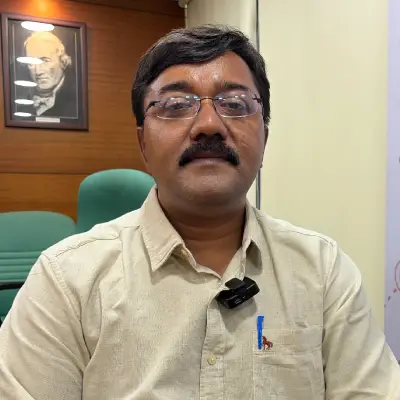
In this episode of the CleanCarbon.ai Podcast, Mr. Saikat Dutta, Director at EEPC India (Engineering Export Promotion Council under the Ministry of Commerce and Industries), speaks with climate journalist and EU CAM export Mr. Shubham Thakur, and breaks down the CBAM operational challenges, CBAM cost inflation, and CBAM reporting data accuracy hurdles facing Indian exporters and MSMEs.
Mr. Shubham Thakur (Interviewer): So industry is preparing to comply with CBAM because there is no other way. They don’t want to lose the market in Europe. Carbon intervention is needed to ensure such carbon emission figures are there. This is a serious problem, and thanks to your organization for being a technical partner and providing the panelists. It was a very good session. The major challenge is the cost because they operate on very stiff competition and very low margins. Now, this sustainability measure—this environmental clause—will dictate the future trade discourse. Hello and welcome to CleanCarbon.ai, which is India’s end-to-end CBAM compliance platform. I am Shubham Thakur, climate journalist and climate communications specialist. The industry is responding to EU CBAM finally during the definitive regime, and today we have a very important person to talk about how the industry is responding to EU CBAM and what the industry bodies are doing. We have Mr. Saikat Dutta, Director of Policy at EEPC India. Thank you, sir, and first of all, congratulations on being appointed as the nodal agency for EU CBAM. Right, sir, in your opinion and in your experience after talking to multiple industry players from the sector, how do you think the industry is responding to EU CBAM finally?
Mr. Saikat Dutta: Thank you, Shubham. Firstly, the European market is a major market for the engineering sector. We are the nodal agency for CBAM to reach out to industry members, and we are the largest export promotion body. We have around 10,000 members, and steel and aluminum—which are presently subject to CBAM—are two major engineering products exported to Europe. So, any difficulty in the European market is definitely a concern, especially for the MSMEs because of the compliance cost and challenges with respect to getting their firms and operations audited, their knowledge, and everything. So, the industry is preparing because there is no other way. CBAM is now effective from 1st January 2026. So, the industry is preparing to comply because they don’t want to lose their market share in Europe. They have to comply and they are preparing for that.
Shubham Thakur: To say that it has now become a compulsion and there’s no other option other than complying with EU CBAM, also because many more countries—as you know, sir—are coming up with their own CBAM structures, like the UK. Here in India also, we are working on our CCTS scheme, which is also about carbon pricing. Sir, what are the major challenges according to you that the industry, particularly the engineering exports industry, is facing with regards to CBAM compliance?
Mr. Saikat Dutta: See, the CBAM compliance is related to the whole supply chain, not on the finished product. So, all the ingredients or inputs used to make the product are part of CBAM compliance. If you are adding some value to, say, metal, steel, and aluminum, you need to know the emission figures for the steel and aluminum you are procuring. In the next stage of production, you can estimate the amount of carbon emission in your part. But if you don’t have the figures of your precursors—the suppliers—then you can’t give the proper figure. So, getting the figures is a challenge. We have already informed this to the government. Carbon intervention is needed to ensure such carbon emission figures are there. We specifically mentioned that in the case of steel and aluminum, when our downstream industry is procuring from the producers, they’re getting a test certificate. If the CBAM emission figures could be included in the test certificate, that would help. This is a serious problem that needs to be resolved, and government intervention is very important.
"The role of CleanCarbon.ai is critical as it is EEPC India’s extended arm when it comes to empowering industry on empowering EU CBAM compliance. They have been doing great job at creating EU CBAM awareness in the iron and steel industry and aluminium sector."
Mr. Saikat Dutta Director of Policy, EEPC India (Ministry of Commerce and Industry)
Shubham Thakur: The government has also said that it will support MSMEs with regards to EU CBAM compliance and it’s working on that. You have also been appointed as the first nodal agency in India with regards to iron, steel, and aluminum to help the industry. What role do you think EEPC India can play, and how is it helping the industry when it comes to empowering and helping them in their competitive edge with regards to EU CBAM?
Mr. Saikat Dutta: This is two parts. Firstly, the knowledge part: educating them and creating awareness. That is what we are doing today. We had a session in Ahmedabad, a session in Delhi. We have planned to organize such awareness sessions all over India, including tier-two and tier-three cities. Simultaneously, we are planning to organize such sessions virtually. We are also planning to include virtual training programs available on our website. This is one part. Second is the MSMEs; the major challenge is the cost because they operate on very stiff competition and very low margins. So for them, the additional cost burden will be a difficulty to maintain competitiveness. We requested the government, and they are acknowledging that under the TReDS scheme and export promotion mission, some support is being worked out. We have requested that at least 80% to 90% of the cost incurred in the auditing process be extended to MSMEs.
Shubham Thakur: So you have requested the government to some extent, and they are discussing this in various forums to understand the cost implications. There’s a lot of talk about CBAM report verification, and the European Union commission has so far published just two or three agencies at the time of recording this podcast. What role do you think verification agencies could play, and how will this be carried out, because one or two players in the entire world cannot carry out verification for lakhs of companies?
Mr. Saikat Dutta: True. We expect that more names of verifiers will be published soon by the EU. On behalf of the Government of India, NABCB is the nodal agency. They are looking into it and talking to NAB in the European Union. We have also requested the government, as we have already finalized our FTA with the European Union, that within that FTA framework, we can work out some MRA (Mutual Recognition Agreement) kind of arrangement so they will recognize our NABCB-affiliated agencies. Industry members need a clear list of verifiers they should approach, and that information should be available on the government portal.
Shubham Thakur: There was a lot of emphasis put on data accuracy because if you do not collect accurate data under the CBAM guidelines, not just your tax will be inflated, but there will be a penalty also. What role do you think accuracy of data can play in CBAM compliance, and what is the advice to all the exporters impacted directly and indirectly by CBAM?
Mr. Saikat Dutta: They should know how to get their audit done, and for that, I think organizations like yours would help the industry. Your role is very critical as an extended arm of EEPC. The second option is the default factor. But a lot of people say that default values will actually mean three or four times the actual tax. The problem is this default value is incremental—in 2026 it’s 10%, 2027 it will be 20%, 2028 it will be 30%. The challenge is the default value will increase and the benchmark will decrease. The benchmark is the permissible limit. Within the permissible limit, there is no tax. Say, for example, in the case of steel, if you are producing 2.5 tons for one ton of steel and the permissible limit is 1.35 tons, this 1.15 tons will be subject to the CBAM tax. So the benchmark will come down; ultimately, whatever product you export to the EU will be subject to carbon tax. Net zero is the target, and the EU is very strict on that.
Shubham Thakur: It’s a very important point that you are making, because we have not been integrating sustainability as much as we should have. Now, as the world becomes climate-conscious, most of the companies are asking for your carbon tax. How important is it for any business, particularly exporters, to at least start thinking about their environmental impact?
Mr. Saikat Dutta: Our government mentioned that we have signed the ‘mother of all trade deals’—the FTA with the EU. Once it is implemented in the first quarter of the next financial year, the tariff for most products will be zero. So, tariffs will no longer be a challenge for market access. For market access, these sustainability measures will determine your market share and penetration. Businesses will have to prepare themselves according to these new global practices. There is no other way.
Shubham Thakur: For the businesses who are really concerned about this, do you think that if the industries respond to CBAM correctly, accurately, and in a timely manner, it could also help them turn this into an opportunity in terms of expanding market share and being a reliable partner when other CBAMs come?
Mr. Saikat Dutta: Definitely, any threat comes with an opportunity. But the moment the industry starts preparing according to the new normal, it will give results and benefits to them. EU is the beginning, but it will be followed by many other countries. This is the right time to start.
Shubham Thakur: Finally, sir, what is your advice and suggestion to all the exporters and anyone who is impacted by CBAM?
Mr. Saikat Dutta: My advice would be to follow all the information and regulations. We cannot just ignore this. Don’t consider this as a challenge; consider this as a new discourse and a new framework. You have to know it and get into it. EEPC India is going to help the industry in all the ways possible. Our website has a dedicated page on CBAM, and we are developing a calculator, a chatbot, e-learning material, and a CN code conversion tool. This toolkit will help the industry.
Shubham Thakur: Absolutely. So that is how EEPC India is helping the industry comply with CBAM. It’s not an option; it’s a passport to your export success and also a currency to expand your businesses. Thank you so much, sir, for talking to us. Thank you for watching this podcast. Please visit the EEPC India website and its empanelled partner CleanCarbon.ai’s website for any queries on CBAM.