
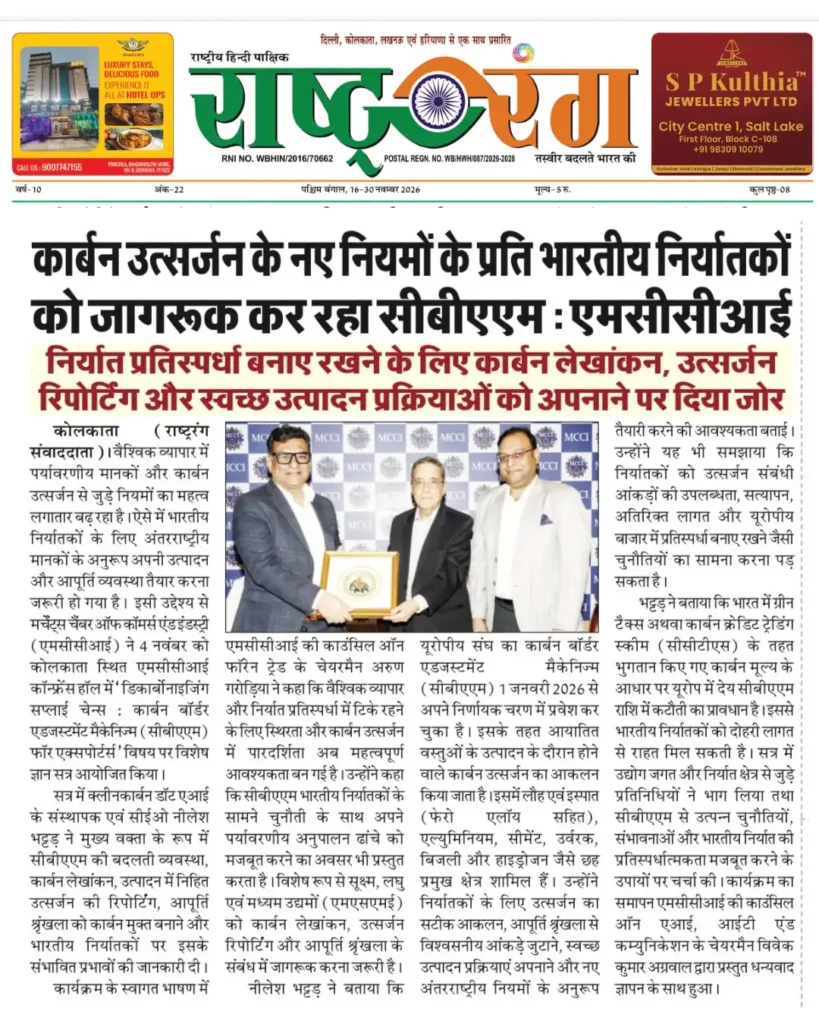
Leading Hindi fortnightly publication Rashtrarang (16–30 November 2026 edition) featured CleanCarbon.ai and Founder & CEO Mr. Nilesh Bhattad following a special knowledge session organized by the Merchants’ Chamber of Commerce & Industry (MCCI) in Kolkata.
Titled “Decarbonizing Supply Chains: Carbon Border Adjustment Mechanism (CBAM) for Exporters,” the session focused on preparing Indian manufacturers and MSMEs for stricter international carbon emission norms and preserving export competitiveness.
Key Insights from the MCCI Kolkata Session
1. Transparency & Carbon Accounting as Trade Imperatives
In his welcome address, Mr. Arun Kumar Garodia, Chairman of MCCI’s Council on Foreign Trade, emphasized that sustainability and transparency in carbon emissions have become essential requirements to remain competitive in global export markets. He noted that while CBAM presents regulatory challenges, it also offers Indian exporters—especially MSMEs—an opportunity to strengthen environmental compliance, carbon accounting, and emissions reporting frameworks.
2. Navigating the Definitive Phase of EU CBAM
Addressing industry representatives as the keynote speaker, Nilesh Bhattad explained that the European Union’s Carbon Border Adjustment Mechanism (CBAM) entered its definitive phase on 1 January 2026. Under this framework, embedded carbon emissions generated during production are assessed across six core sectors:
- Iron & Steel (including Ferro-Alloys)
- Aluminium
- Cement
- Fertilizers
- Electricity
- Hydrogen
Bhattad highlighted that exporters must address critical hurdles—including reliable supply chain data collection, third-party verification, and cost management—to safeguard their market share in Europe.
3. Leveraging India's Carbon Credit Trading Scheme (CCTS)
A major highlight of the session was explaining how domestic carbon pricing mechanisms interact with EU CBAM. Mr. Nilesh Bhattad clarified that carbon prices or green taxes paid in India under the Carbon Credit Trading Scheme (CCTS) qualify for deductions against CBAM liabilities payable in Europe—providing Indian exporters crucial relief from double carbon costs.
The session concluded with a vote of thanks delivered by Mr. Vivek Kumar Agarwal, Chairman of MCCI’s Council on AI, IT & Communication.
How CleanCarbon.ai Supports Indian Exporters
CleanCarbon.ai equips Indian manufacturers, steel producers, and MSMEs with AI-powered carbon accounting and EU CBAM compliance software. By automating Scope 1, Scope 2, and embedded Scope 3 emissions tracking across multi-tier supply chains, we help exporters generate audit-ready reports, avoid default-value penalties, and transition smoothly toward clean production.