
Executive Summary
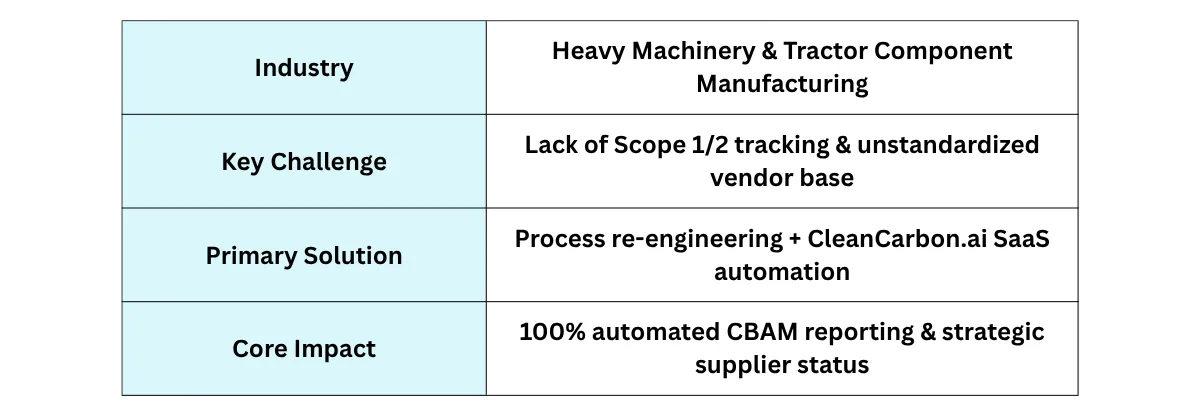
When European Union buyers began requesting embedded emissions data under the Carbon Border Adjustment Mechanism (CBAM) in 2024, Yerik International faced a critical operational challenge. As a manufacturer dealing in energy-intensive forging, machining, and chemical finishing, the company had limited internal capabilities to account for complex Scope 1 and Scope 2 parameters—let alone trace precursor emissions across its unstandardized supplier base.
By combining lean manufacturing principles, shop-floor re-engineering, and CleanCarbon.ai’s automated reporting platform, Yerik International eliminated data bottlenecks, upgraded vendor compliance, and secured preferred supplier status across European export markets.

The Challenge: Unprepared Supply Chains & Fragmented Data
In 2024, initial compliance requests from European clients exposed significant operational gaps typical of heavy industrial exporters in developing markets:
- In-House Knowledge Deficits: Lack of baseline carbon accounting protocols for tracking electricity grid mixes, hydraulic oils, LPG, cutting fluids, and paint shop chemicals.
- Material Safety Data Sheet (MSDS) Complexity: High technical friction in analyzing fuel properties and applying appropriate emission factors.
- Tier-2/3 Supplier Unreadiness: Vendors had no ISO standards, lacked material-processing tonnage records, and only logged incoming/outgoing shipments.
- Margin Compression: Importers refused to pay premiums for compliance data, making operational cost absorption necessary.
Operational Roadmap: The Compliance Transformation Process
Yerik International executed a structured, multi-tier strategy to modernize its operations and ensure full compliance.
1.Comprehensive On-Site Audits: Initial baseline diagnostic.
Partnered with CleanCarbon.ai to conduct technical plant visits, identifying key emission hotspots across grid usage, furnace fuels, and chemical inputs.
2.Supply Chain Restructuring & Vendor Engagement: Mandatory data integration.
Enforced vendor data collection through direct field visits, top-management escalations, and a strict policy: offboarding suppliers incapable of providing verifiable precursor metrics.
3.Shop-Floor Decarbonization:Process re-engineering.
Replaced high-polluting furnace oils with eco-friendly graphite lubricants, switched to biodegradable cutting fluids in machining centers, retrofitted heat-treatment burners, and integrated rooftop solar energy.
4.SaaS Automation Implementation:Transition from Excel to Dashboard.
Migrated from error-prone Excel spreadsheets to CleanCarbon.ai’s central dashboard to automate complex precursor mapping, fuel tracking, and report generation.
Key Results & Business Impact
Yerik International converted a regulatory burden into a long-term business asset:
- Instant Audit Readiness: Transformed multi-week manual spreadsheet calculations into single-click historical report retrieval for European client audits.
- Cost Offsetting via Lean Principles: Merged lean manufacturing initiatives with CBAM compliance to eliminate non-value-adding operational waste, effectively neutralizing compliance overheads.
- Competitive Market Positioning: Established a structural advantage over non-compliant regional competitors as EU buyers increasingly prioritize compliance-ready exporters ahead of definitive tariff deadlines.
| Manual Excel Tracking | CleanCarbon.ai Automated SaaS |
|---|---|
| High manual error rate | Standardized data inputs |
| Fragmented vendor spreadsheets | Centralized precursor mapping |
| Slow multi-week compilation | Single-click report generation |
| Difficult multi-year audits | Instant historical retrieval |