
Executive Summary & Regional Context
Under the European Union’s Carbon Border Adjustment Mechanism (EU Regulation 2023/956), primary steelmaking represents one of the most heavily scrutinized import categories. EU importers bringing primary iron, steel sections, and flat-rolled products into European member states must declare direct (Scope 1) and indirect (Scope 2) embedded greenhouse gas emissions, alongside upstream raw material footprints (Scope 3 precursor inputs).
Jagdamba Steels Limited, established in 1994, is Nepal’s premier steel manufacturer, operating a massive rolling mill capacity of 3,000 Metric Tons (MT) per day. The company produces a wide spectrum of structural and finished steel products, including TMT Bars (Rhino 500D / Jagdamba E), HR/CR Coils & Sheets, MS Angles, Channels, Beams, and Galvanized Wires.
As Jagdamba Steels expanded its international export footprint, an export consignment faced an emergency detention at European Union customs due to missing, validated CBAM carbon declarations. Partnering with CleanCarbon.ai, Jagdamba Steels rapidly resolved the logistics hold and established a multi-facility Measurement, Reporting, and Verification (MRV) platform across its integrated manufacturing ecosystem.
Technical Complexity in High-Volume Primary Steel Accounting
Calculating product-level carbon footprints (PCF) across an integrated 3,000 MT/day rolling and re-rolling environment involves distinct metallurgical and accounting challenges:
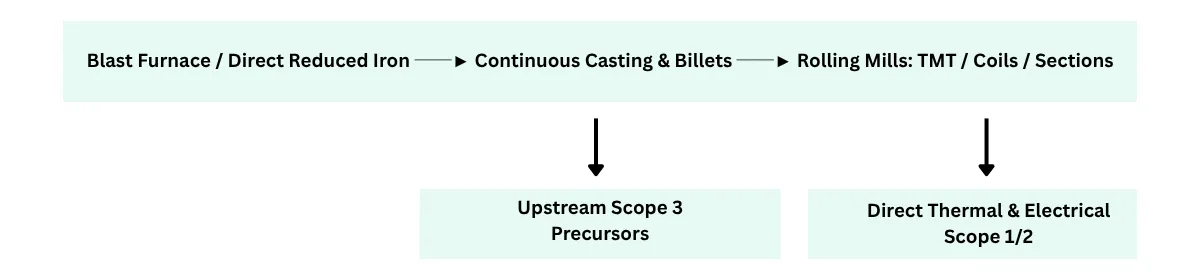
- Precursor Iron & Billet Data Isolation (Scope 3): Under EU CBAM mandates for primary steel, calculations must incorporate the embedded emissions of upstream raw materials—such as Direct Reduced Iron (DRI), pig iron, or imported steel billets—requiring verified data integration across third-party supply chains.
- Multi-Line Energy Attribution: Operating heavy-duty reheating furnaces, continuous casting units, and high-speed rolling mills generates varying direct fuel (Scope 1) and electricity (Scope 2) intensities across different finished products (e.g., TMT bars vs. thin-gauge cold-rolled coils).
- Broad Tariff Code Spectrum: Exporting diverse product lines requires granular emission mapping across several EU Combined Nomenclature headings:
- CN Code 7213 / 7214: Bars and rods of iron or non-alloy steel (TMT Bars / Rebar).
- CN Code 7208 / 7209 / 7210: Flat-rolled products of iron or non-alloy steel (HR/CR Coils & Sheets, Galvanized Plates).
- CN Code 7216: Angles, shapes, and sections of iron or non-alloy steel (MS Channels & Beams).
Relying on unverified generic data forces EU buyers to apply EU default emissions values set at the top 90th percentile of carbon intensity, severely inflating calculated import taxes.
The CleanCarbon.ai Implementation Framework
CleanCarbon.ai deployed a structured compliance protocol to address both immediate port logistics and long-term facility automation:
- Emergency Customs Verification: Ingested furnace energy logs, billet material certificates, and batch production metrics to build a fully verified CBAM declaration report, securing the release of the detained export shipment at European customs within days.
- Upstream Vendor Engagement Portal: Implemented simplified web-based submission tools and conducted technical workshops for upstream raw material suppliers, accelerating the collection of primary precursor emissions data.
- Automated ERP-to-XML Engine: Integrated facility ERP and production control logs directly into the CleanCarbon.ai system, automating quarterly XML file generation pre-formatted for direct upload to the official EU CBAM Transitional Registry.
Operational & Strategic Outcomes
The deployment of CleanCarbon.ai transformed compliance management across Jagdamba Steels’ large-scale operations:
| Compliance Metric | Incident State (Pre-Intervention) | CleanCarbon.ai Integrated System |
| Customs Clearance Status | Shipment detained at EU port | Shipment released in days; zero demurrage accrued |
| Quarterly Reporting Time | Weeks of manual calculation across mills | Automated real-time file generation |
| Precursor Data Integrity | Unverified or missing vendor logs | High supplier data submission rates via portal |
| CBAM Tax Risk Profile | Exposure to 90th percentile default rates | Declared actual verified primary emissions |
Leadership Perspective
Frequently Asked Questions
Why are TMT bars, HR/CR coils, and structural steel subject to EU CBAM?
Primary steel products, rebar (TMT bars), flat-rolled coils, and structural sections under CN codes 7213, 7214, 7208, 7209, and 7216 fall directly within the scope of EU Regulation 2023/956. EU importers bringing these materials into Europe must report direct, indirect, and precursor embedded emissions quarterly.