
Overview & Regulatory Background
The European Union’s Carbon Border Adjustment Mechanism (CBAM) under EU Regulation 2023/956 fundamentally altered the export dynamics for energy-intensive metallurgy. Importers across EU member states are mandated to declare embedded direct (Scope 1) and indirect (Scope 2) greenhouse gas emissions for covered industrial imports.
Hira Power & Steels Limited—a flagship unit of the Hira Group based in Raipur, Chhattisgarh—is a major Indian manufacturer and exporter of ferro alloys. Operating submerged arc smelting furnaces, dolomite/limestone mining units, and captive power plants, Hira Power & Steels produces high-grade Ferro Silicon, Silico Manganese, and Medium/Low Carbon Ferro Manganese.
To protect its European export lines and maintain supplier preference among EU steelmakers, Hira Power & Steels partnered with CleanCarbon.ai to establish an automated, facility-wide Measurement, Reporting, and Verification (MRV) infrastructure.
Technical Complexity in Ferro Alloy Carbon Footprinting
Calculating embedded emissions for ferro alloys introduces complex metallurgical and energy-allocation challenges under EU CBAM frameworks:
- High-Temperature Reduction Smelting: Submerged arc furnace operations require continuous electrical energy and carbonaceous reductants (coke, coal, charcoal), generating high direct process emissions during carbothermic reduction.
- Captive Power & Grid Balancing: Differentiating between internal thermal power generation, captive renewable consumption, and grid electricity exports requires real-time data segregation to determine accurate indirect (Scope 2) emission factors.
- EU Default Rate Penalties: In the absence of primary, facility-specific emissions disclosures, EU customs assigns standardized default carbon values set at the top 90th percentile of EU production intensity. For high-volume alloy exporters, default rates create artificial tariff penalties that erode export pricing margins.
CleanCarbon.ai Operational Integration Architecture
CleanCarbon.ai integrated its carbon accounting platform across Hira Power & Steels’ Raipur manufacturing complex, converting facility energy logs into EU-compliant reporting datasets:
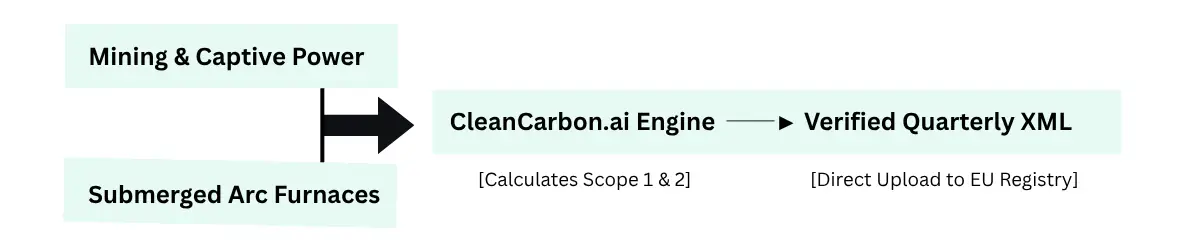
- Facility-Wide Data Ingestion: Systematically linked fuel combustion metrics, reductant consumption, and power distribution logs across captive power generation and smelting furnaces.
- CN Code Emission Mapping: Calculated precise product-level carbon footprints (PCF) aligned with EU CBAM Heading 7202 (Ferro-alloys), covering subheadings for ferro-manganese (7202 11 / 7202 19), ferro-silicon (7202 21 / 7202 29), and ferro-silico-manganese (7202 30).
- Automated XML Export Generation: Transformed raw operational data into verified quarterly XML declaration files pre-formatted for direct submission into the EU CBAM Transitional Registry.
Strategic Business Outcomes
The deployment of CleanCarbon.ai delivered quantifiable operational and commercial benefits for Hira Power & Steels Limited:
| Metric | Pre-Automation Standard | CleanCarbon.ai Integrated System |
|---|---|---|
| EU Tariff Risk | Vulnerable to 90th percentile default penalties | Declared actual verified primary emissions |
| Data Integrity | Fragmented spreadsheet logs across units | ISO 14064-aligned, audit-ready digital system |
| Reporting Cycle Time | Weeks of manual data compilation | Automated real-time quarterly file creation |
| EU Market Access | Risk of customs delays or buyer friction | Uninterrupted export clearance to EU clients |
Long-Term Decarbonization Roadmap
By establishing primary carbon visibility across its smelting operations, Hira Power & Steels Limited continuously evaluates energy optimization opportunities across furnace feeds and captive power generation. This proactive compliance model safeguards product margins against future EU ETS carbon price adjustments while reinforcing the company’s position as a low-carbon alloy manufacturer.
Frequently Asked Questions
Why are ferro alloys subject to EU CBAM declarations?
Ferro-alloys under CN code 7202 (including ferro-silicon, ferro-manganese, and silico-manganese) are designated energy-intensive goods under EU Regulation 2023/956. European importers bringing these materials into the EU must report direct and indirect embedded carbon emissions quarterly.
How does reporting primary emissions data protect alloy exporters from default penalties?
If an exporter fails to supply primary plant data, EU buyers must apply default values based on high carbon intensity assumptions. Reporting primary, verified emissions through CleanCarbon.ai reflects exact plant efficiency, ensuring buyers are not subject to inflated carbon tax calculations.