
Case Overview & Incident Summary
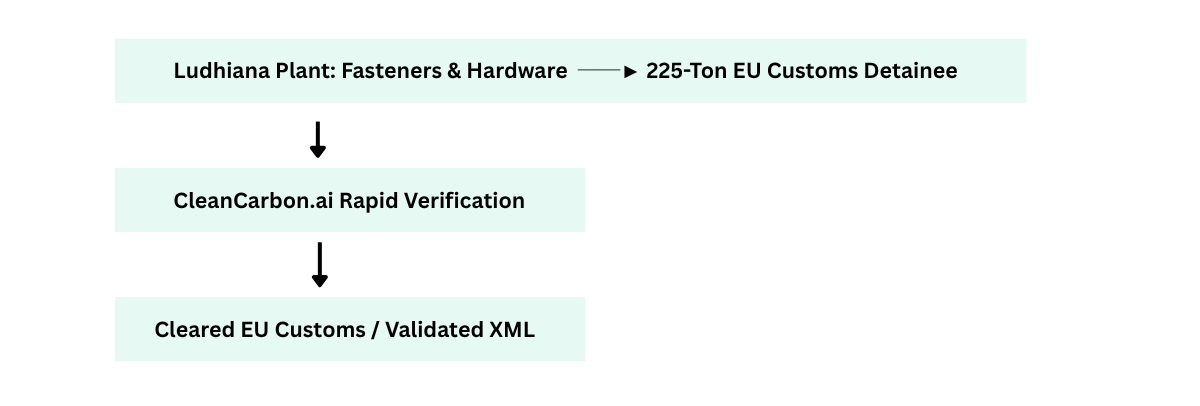
When a 225-ton export shipment of steel scaffolding, industrial fasteners, and tractor components was held at European Union customs due to missing carbon accounting documentation, Ludhiana-based Gravity Engineering Works faced immediate demurrage costs and severe supply chain disruption.
Gravity Engineering Works manufactures high-volume industrial hardware, gate fittings, bolts, and agricultural tractor components exported throughout EU member states. Because steel-intensive hardware falls directly under the European Union’s Carbon Border Adjustment Mechanism (EU Regulation 2023/956), shipments entering EU ports without primary carbon emissions declarations risk immediate customs detentions or severe default tax penalties.
By deploying CleanCarbon.ai, Gravity Engineering Works generated validated, audit-ready CBAM documentation to release the 225-ton shipment within days, while building a permanent, automated compliance infrastructure for future export runs.
Technical & Regulatory Footprint
- Multi-Tariff Classification Complexity: Gravity Engineering’s product lines span CN Code 7308 (Structures and Parts of Structures), CN Code 7318 (Screws, Bolts, Nuts, Rivets, and Washers), and CN Code 7326 (Other Articles of Iron or Steel). Each tariff heading requires itemized Scope 1 (direct fuel/heating) and Scope 2 (electricity) embedded emissions tracking.
- Upstream Supplier Data Silos: Calculating accurate product carbon footprints (PCF) required collecting verified primary emissions data from upstream raw steel suppliers and billet vendors without slowing down order fulfillment.
- Severe Demurrage & Default Risks: Customs holds incur escalating daily port storage fees. Relying on unverified generic data forces EU buyers to apply default emissions values set at the top 90th percentile of EU production intensity, artificially inflating carbon costs.
The CleanCarbon.ai Rapid Response Protocol
CleanCarbon.ai executed a phased deployment designed to resolve the immediate logistics crisis before transitioning to facility-wide automation:
- Phase 1 (Immediate Customs Mitigation): Within days of engagement, CleanCarbon.ai mapped operational batch data, fuel consumption logs, and material test certificates to compile a verified CBAM declaration report, securing the release of the 203-ton shipment at EU customs.
- Phase 2 (Supplier Onboarding & Training): Deployed simple data collection tools and conducted practical demonstrations for upstream steel vendors, significantly increasing primary supplier data submission rates.
- Phase 3 (Automated Quarterly Reporting Engine): Integrated production system logs into CleanCarbon.ai’s platform, enabling automatic quarterly XML file generation formatted for direct submission to the EU CBAM Transitional Registry.
Operational & Commercial Outcomes
The strategic intervention by CleanCarbon.ai transformed an operational liability into a scalable trade advantage:
| Performance Metric | Pre-Intervention (Incident State) | Post-Automation Outcome |
| Customs Clearance Status | 225-ton shipment detained at EU port | Shipment released in days; zero demurrage |
| Quarterly Reporting Effort | Manual spreadsheets & delayed inputs | Automated real-time report generation |
| Supplier Data Accuracy | Fragmented, unverified vendor logs | High supplier submission rates via guided portal |
| Compliance Risk Profile | High exposure to late fees & default rates | 100% audit-ready, GDPR-compliant datasets |
Executive Statement
— Managing Director, Gravity Engineering Works
Frequently Asked Questions
Why are steel fasteners, bolts, and agricultural hardware subject to EU CBAM?
Steel fasteners and hardware under CN code 7318 and agricultural steel components under CN codes 7308/7326 are designated carbon-intensive iron and steel goods under EU Regulation 2023/956. EU importers bringing these products into Europe must declare direct and indirect embedded emissions quarterly.
How can exporters prevent shipments from being detained at EU customs under CBAM rules?
Exporters can prevent customs holds by providing EU importers with validated, facility-specific Scope 1 and Scope 2 primary emissions datasets in official EU CBAM XML format ahead of arrival at European entry ports.