CBAM 2026 has many mandatory rules for exporters during the definitive phase. In this blog, the Ministry of Commerce and Industries’ EEPC India’s official CBAM consultant CleanCarbon.ai is helping Indian iron and steel exporters in their CBAM journey.
CBAM 2026 Explained for Iron and Steel Manufacturers
With CBAM Explained, CBAM 2026 stands for Carbon Border Adjustment Mechanism, which is a mirror image of the European Union Commission’s Trading System (EU ETS). CBAM 2026 put a carbon levy on the import and export of carbon-intensive products to the EU from 2026. CBAM was introduced to prevent carbon-leakage, a scenario where companies producing carbon-intensive items in the EU would shift their production to other countries with lax carbon policies to evade their own internal carbon tax in the EU. In order to prevent this leakage of carbon emissions and trade barriers due to carbon emissions, and to ensure global decarbonisation, the EU came up with CBAM 2026 rules and regulations.
Ministry of Commerce and Industries Makes EEPC India Nodal Body on CBAM
The Ministry of Commerce and Industries has been very proactive in responding to CBAM 2026 since the start. Recently, it also appointed the EEPC India as the designated Nodal Body for iron and steel and aluminium to guide the industry in meeting strict CBAM reporting requirements, data readiness, verification and timely reporting.
EEPC India of Ministry Commerce and Industries Appoints CleanCarbon.ai as Official CBAM Consultant

EEPC India, under the Ministry of Commerce and Industries, has officially appointed CleanCarbon.ai as the first point of contact for helping its members and Indian iron, steel, and aluminium exporters overcome CBAM Reporting Challenges for Indian Suppliers to achieve full CBAM Compliance.
The official appointment of CleanCarbon.ai as the CBAM consultant for EEPC India reposes faith in the accurate compliance work done by the CleanCarbon team for Indian exporters. So far, cleancarbon.ai has trained and empowered many hundreds of EEPC India members in their CBAM 2026 reporting journey.
Cleancarbon is the CBAM only reporting platform which has helped more than 400 companies and generated close to 10,000 CBAM reports in India and globally. CleanCarbon.ai is the No. 1 CBAM 2026 reporting company in India and the world.
CBAM 2026 for Iron and Steel and Aluminium Sectors
CBAM 2026 covers six sectors such as cbam for iron and steel, aluminium, cement, fertilisers, hydrogen and electricity. Across the evolving CBAM landscape, all these sectors are highly carbon-intensive and export to the EU.
| Sectors | CN Code |
|---|---|
| Iron and Steel | CN Code 72 Series and Selected Items from CN Code 73 Series |
| Aluminum | CN Code 76 Series |
| Cement | CN Code 27 Series |
| Fertilisers | CN Code 23 and 32 Series |
| Hydrogen | CN Code 2804 10 00 |
| Electricity | CN Code 2716 00 00 |
CBAM 2026: Mandatory Rules Iron and Steel Sector
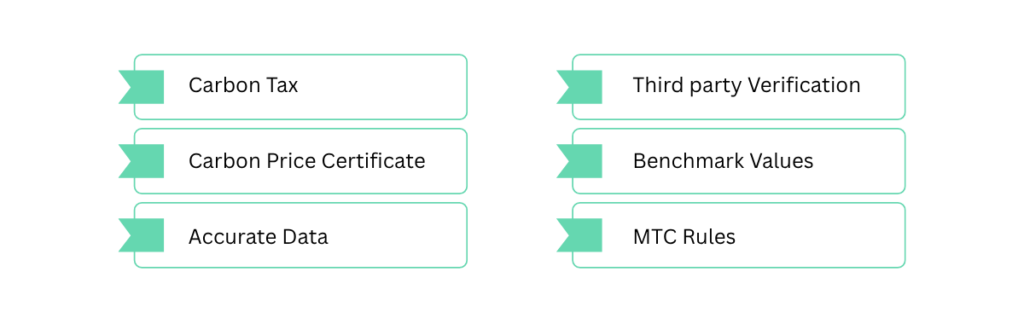
Carbon tax: CBAM 2026 rules make carbon tax mandatory for EU importers and buyers. All the importers are required to pay CBAM tax as per carbon emissions embedded in their imports from India and other countries. The carbon tax will be calculated on the basis of quarterly data available from January 2026, but the payment has to be completed in 2027. The liability to pay carbon tax lies on the EU importers and buyers under CBAM 2026. However, some suppliers have witnessed the tax burden being percolated down to them from the Euro[ean buyers for their carbon emissions.
Carbon Price Certificate: Understanding CBAM certificates : Process, Requirements & Benefits is vital asCBAM 2026 mandates quarters CBAM certificate price for all importers on the basis of their imported volume. This will be issued to EU buyers by EU authorities upon receiving the Carbon emissions data report. The certificate price will keep changing every quarter as per market fluctuations. The CBAM 2026 certificate price for quarter 1 is EUR 75.36 and quarter 2 is EUR 75.28.
Accurate Data: CBAM 2026 mandates collection, compilation and submission of accurate and traceable emissions data. Any inaccuracies in this can either cause inflated carbon tax and penalties or both for the importers.
Third party Verification: CBAM 2026 has also mandated all CBAM reports to be validated and verified by a third-party and independent agency. This means the list of verifiers approved by the EU will be published soon on their website and CBAM reports validated by them only can be accepted by the EU. This will start from late 2026.
Benchmark Values: The commission has also published the benchmark values for all sectors. Under the EU Carbon Border Adjustment Mechanism (CBAM), a benchmark value is essentially a reference emissions-intensity value used by the EU to determine the level of free allocation adjustment and, in certain cases, to select the appropriate benchmark when default values are used. This is used for free allocations calculations.
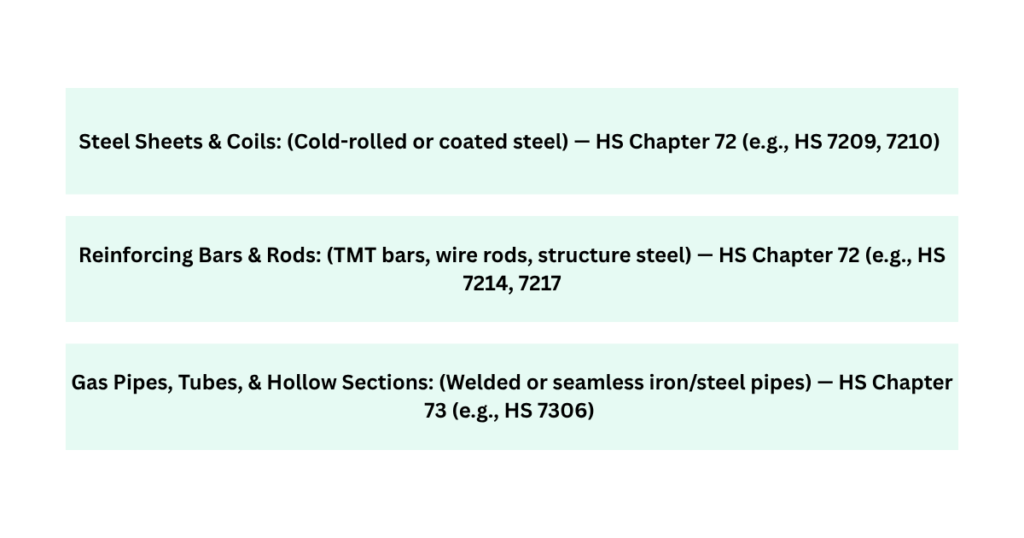
Mill Test Certificate (MTC): Under the CBAM 2026 rules, EU customs will mandatorily verify “Country of Melt and Pour” (the country where the raw steel was originally melted in a furnace and cast into a solid shape like a billet or slab) for all incoming steel products. Failure to submit correct documents will mean rejection of shipment to the EU market. This rule is applicable for the iron and steel sector only.
Which products and items under the iron and steel are covered under this rule?
As per the CBAM 2026 rules, only selected HSN/CN codes are mandated to submit the Mill Test Certificate to ensure verification of “Country of Melt and Pour”. Here is a look at them:
Documents required under for verification of steel origin:
- The Mill Test Certificate (MTC) is now the mandatory primary proof.
- Your factory MTC must clearly print two fields for every batch:
- The Country of Melt and Pour (e.g., Melt & Pour: India)
- The specific Heat Number / Batch Number
SEFA Calculation Rules Under CBAM 2026
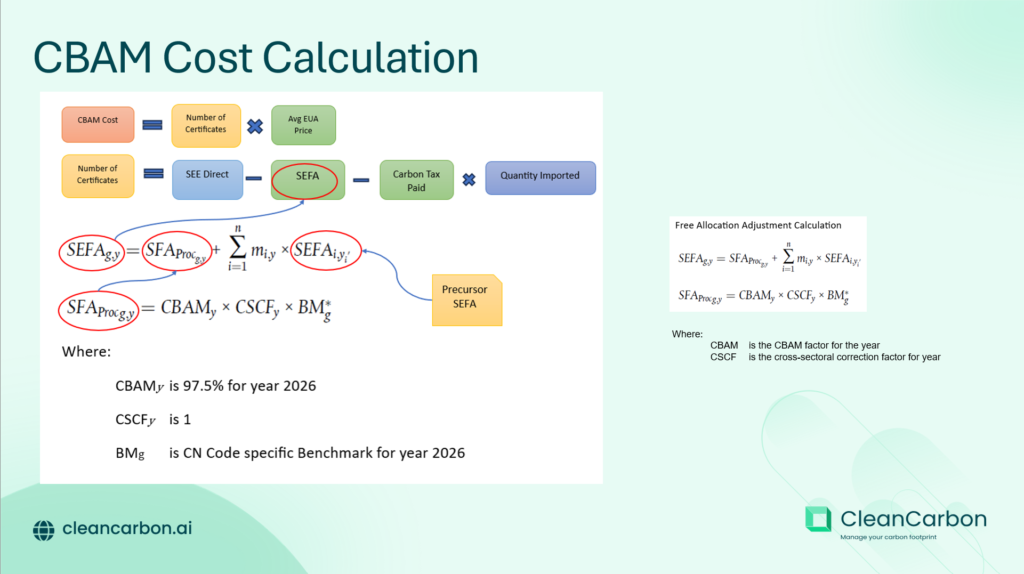
SEFA Calculations under CBAM 2026: SEFA — Specific Embedded Free Allocation — is a defined term under the CBAM regulatory framework that quantifies the portion of a good’s embedded emissions deemed to be covered by free allocation, mirroring the free EU ETS allowances that competing EU domestic producers still receive during the ETS phase-out period.
Codified through Commission Implementing Regulation (EU) 2025/2620, SEFA sits alongside the CBAM factor, the cross-sectoral correction factor (CSCF), and CBAM benchmark values as one of the core parameters used to convert gross embedded emissions into a net CBAM certificate liability. In effect, SEFA operationalizes the principle that importers should not pay twice for a decarbonization cost that EU producers have not yet fully absorbed themselves.
Purpose and Role of SEFA: SEFA exists to preserve equivalence between the EU ETS and CBAM during the transition years, ensuring imported goods are not disadvantaged — or EU producers over-protected — while free allocation is phased down. Structurally, it functions as a deduction: the Free Allocation Adjustment (FAA), calculated as SEFA multiplied by the total mass of goods imported in the reporting year, is subtracted from total embedded emissions before the number of CBAM certificates to be surrendered is determined.
Because the EU ETS free allocation itself is on a declining schedule — starting at 97.5% in 2026 (CBAM factor of 2.5%) and falling to 0% by 2034 — SEFA’s magnitude shrinks correspondingly each year, progressively increasing the effective carbon cost borne by importers until full exposure is reached in the definitive regime.
How to Calculate SEFA Under CBAM 2026 Rules? SEFA is calculated differently depending on whether an operator relies on default values or verified actual (primary) data, and differently again for simple versus complex goods.
SEFA Calculations Using Default Values: SEFA = CBAM factor × CBAM benchmark value (Column B) × Cross-Sectoral Correction Factor (CSCF). The CBAM benchmark values are published under Implementing Regulation (EU) 2025/2621, differentiated by CN code and, where relevant, country-specific default production route; the CSCF was set at 1 for 2021–2025.
SEFA Calculations 2026 Using Actual Data (simple goods): the operator calculates a process-level specific free allocation using the same three parameters — CBAM factor, CSCF, and the process-related CBAM benchmark — applied to the installation’s verified emissions data. For simple goods, this process-level value equals SEFA directly.
SEFA Calculations 2026 Using Actual Data (complex goods): SEFA must additionally incorporate the embedded free allocation of every precursor consumed in production. This requires a recursive calculation: each precursor’s SEFA is determined either from the relevant benchmark (aligned to the correct reporting period) or from verified producer-level data, and then combined in proportion to the specific mass of precursor consumed per tonne of final good.
How to Calculate Emissions and CBAM Tax?
CBAM 2026 rules have mandated iron and steel sector categories such as the fasteners, wires, tubes, valves, pipes, iron rods, etc to calculate their quarterly CBAM tax using accurate emissions data. As per the published carbon tax rates for quarter 1 and quarter 2, EU buyers of Indian products will have to pay around INR 9,000 per tonne of their embedded carbon emissions. Here is a look at how to calculate CBAM tax:
CBAM Tax=Imported Quantity×(Specific Embedded Emissions−Free Allocation Adjustment)×EUA Carbon Price
How Should Iron and Steel Exporters Prepare for CBAM 2026?
To see CBAM in Action, manufacturers must follow key preparation steps:
- Identify your CBAM applicability and exposure: The first step is to identify whether or not your exported products under the iron and steel are covered by CBAM 2026. You can use our advanced CN Code Checker to identify the CBAMm 2026 applicability.
- Set up data tracking and monitoring system: Second step is to establish a well-synchronised data tracking and monitoring system at your organisation and production units. This must be done by an expert agency like CleanCarbon.ai, which is recognised by the Ministry of Commerce and Industries’ EEPC India office to help in CBAM reporting.
- Start monitoring emissions: Under step third, start actual tracking and monitoring of your emissions. This will help you in identifying emissions hotspots, understanding emissions flows and prevent unwanted emissions that could add up to your carbon tax.
- Verify emissions: Now is the time to start verifying the emissions data that has been collected so far in a compiled format. This must be done as mandated under CBAM 2026. Verification of emissions data helps in correcting if there was any scope of error left. It makes the report split and ensures there is traceability and auditability of all data. The aim is to collect and submit credible and actual embedded emissions data.
- Evaluate your carbon tax: Finally, you can use all the verified emissions data to evaluate your carbon tax and financial implications. This can be done separately for each quarter against the given carbon tax rates at that point in time.
- Report CBAM hassle free to EU: Now you are ready to submit your CBAM report and trade with EU tension free. At this stage, you only have to focus on your exports business.
Why Trust CleanCarbon.ai for CBAM 2026 Compliance?
- EEPC India’s official CBAM consultant: Cleancarbon.ai is official CBAM consultant appointed by the Ministry of Commerce and Industries EEPC India. It is also the official CBAM partner of SEPC under the Ministry of Commerce and Industries.
- CBAM focused platform: Cleancarbon.ai is the only platform which focuses only on end-to-end CBAM reporting. It’s entire energy, resources and attention to helping exporters in CBAM compliance that leaves no scope of error at all. That’s the reason all companies trust Cleancarbon.ai with their CBAM compliance.
- CBAM reporting experience: Cleancarbon.ai has experience in generating 10,000 CBAM reports and helping more than 500 companies in their CBAM journey so far. Their reports have helped many companies take clearance for their shipments stuck at the EU borders and customs officials.
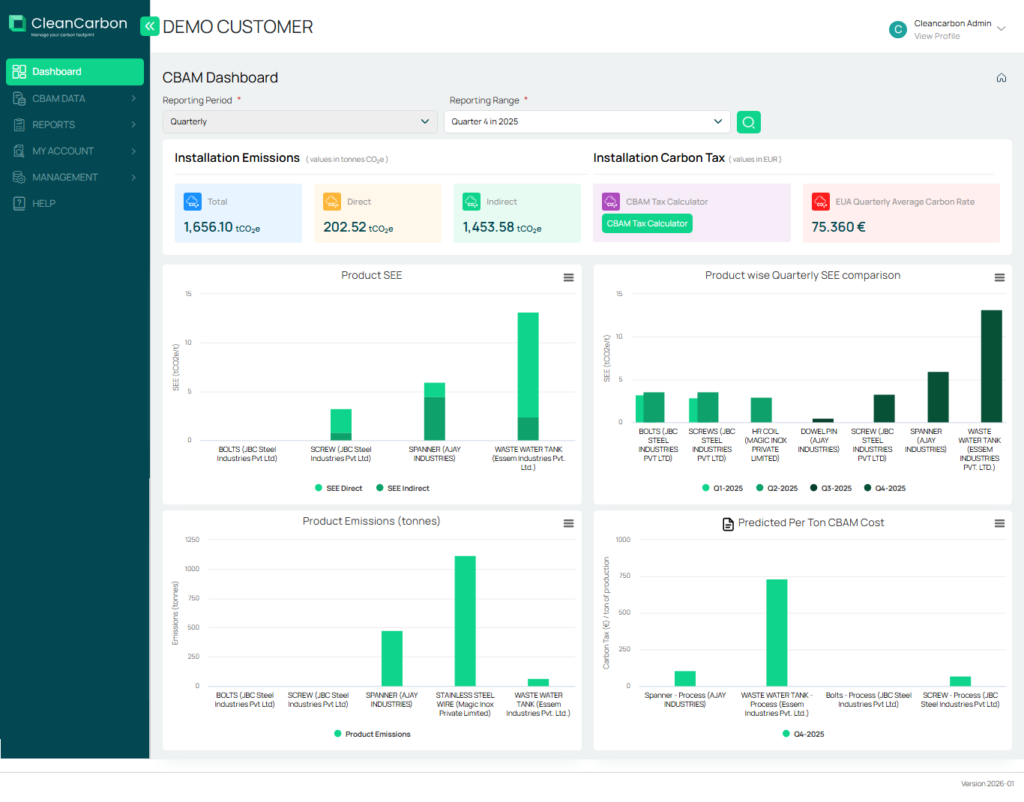
- Simple software: Cleanccarbon.ai has developed such simple software to automate your CBAM compliance that even non-technical employees can use it easily. It has clean and the best software interface that allows not only in data collection but also in identifying emissions hotspots, analysing the emissions data, and understanding exact reasons for increased emissions and taxes. This is the only software that helps you identify whether your products are covered by CBAM or not just by filling product name or CN code. Cleancarbon.ai’s calculation features are so simple that anyone could use them from the website.