Learn how to calculate CBAM costs as an importer in 2026 using the official EU formula, real-world examples, and a practical calculator. This guide explains the key cost factors, compares verified emissions with default values, and shows how foreign carbon price deductions affect your final CBAM liability. It also covers important compliance deadlines and strategies to reduce future CBAM costs.
How to Calculate CBAM Costs as an Importer in 2026 (Examples + Calculator)
The EU’s Carbon Border Adjustment Mechanism entered its definitive phase on 1 January 2026, and the financial stakes are now real. Importers of steel, aluminium, cement, fertilisers, electricity, and hydrogen into the EU face a genuine cost obligation — one that is accruing on every qualifying shipment made from the start of this year, even though certificates will not be purchased and surrendered until 2027. Understanding how to calculate CBAM costs as an importer is no longer a compliance exercise for specialists. It is a core financial planning competency.
This guide explains the official CBAM cost formula, walks through worked examples across different product types, and provides an interactive calculator you can use to estimate your own exposure.
The Core Formula: How CBAM Costs Are Calculated
At its simplest, to calculate CBAM costs as an importer, you apply the following formula:
CBAM Cost = Import Quantity (tonnes) × Embedded Emissions (tCO₂e/tonne) × CBAM Factor × Certificate Price (€/tCO₂e) − Carbon Price Already Paid in the Country of Origin
Each component matters, and getting them right determines whether your cost estimate is accurate or dangerously off.
Breaking Down Each Variable
1. Import Quantity
This is the net mass of CBAM-covered goods imported, measured in metric tonnes. It applies per product category, tracked at the CN code level. The 50-tonne annual threshold introduced by the CBAM Omnibus Regulation (EU 2025/2083) determines whether you are in scope at all — but once you exceed that threshold for a given product category, every tonne counts.
2. Embedded Emissions (tCO₂e per tonne)
This is the greenhouse gas intensity of the goods as produced — the total CO₂ equivalent emitted during their manufacture, expressed per metric tonne of product. For steel and aluminium, this covers direct emissions only (indirect emissions from electricity are excluded at the production level, though they may be included for certain products such as cement and fertilisers, depending on the methodology). This figure must come from the non-EU producer using the EU’s prescribed calculation methodology and, for actual values to be used in a declaration, must be verified by an EU-accredited third-party verifier.
If actual verified data is unavailable, the EU’s conservative default values apply — and from 2026, those defaults carry an additional penalty markup of 10%, rising to 20% in 2027 and 30% from 2028 onward. Using default values is permitted, but it is expensive.
3. The CBAM Factor (Phase-In Adjustment)
CBAM is not immediately applied at 100% of embedded emissions. To mirror the gradual phase-out of free EU ETS allowances, a phase-in factor is applied. In 2026, the CBAM factor is 2.5% — meaning importers pay for only 2.5% of total embedded emissions this year. This ramps up annually, reaching 100% in 2034 when EU free allocations are fully eliminated.
This is an important nuance: while the full embedded emissions figure is what gets reported and verified, the certificate obligation in 2026 covers only a small fraction of that total. The cost will grow materially every year through to 2034.
5. Carbon Price Already Paid in the Country of Origin
If the producer has already paid a carbon price in their home country — through a domestic ETS, a carbon tax, or an equivalent mechanism — that amount can be deducted from the CBAM certificate obligation. This prevents double-charging for the same emissions. The deduction applies only where verifiable evidence is provided, and the eligible carbon price must meet EU recognition criteria. From 2027, the Commission will also publish default carbon price values for countries with established pricing mechanisms where an actual paid price cannot be confirmed.
Worked Examples
Example 1: Steel — Verified Actual Emissions (Blast Furnace Route, Turkey)
An EU importer brings in 10,000 tonnes of hot-rolled coil from a Turkish steel mill operating via the blast furnace–basic oxygen furnace (BF/BOF) route. The supplier provides verified emissions data showing embedded emissions of 2.0 tCO₂e per tonne. No domestic carbon price is paid in Turkey.
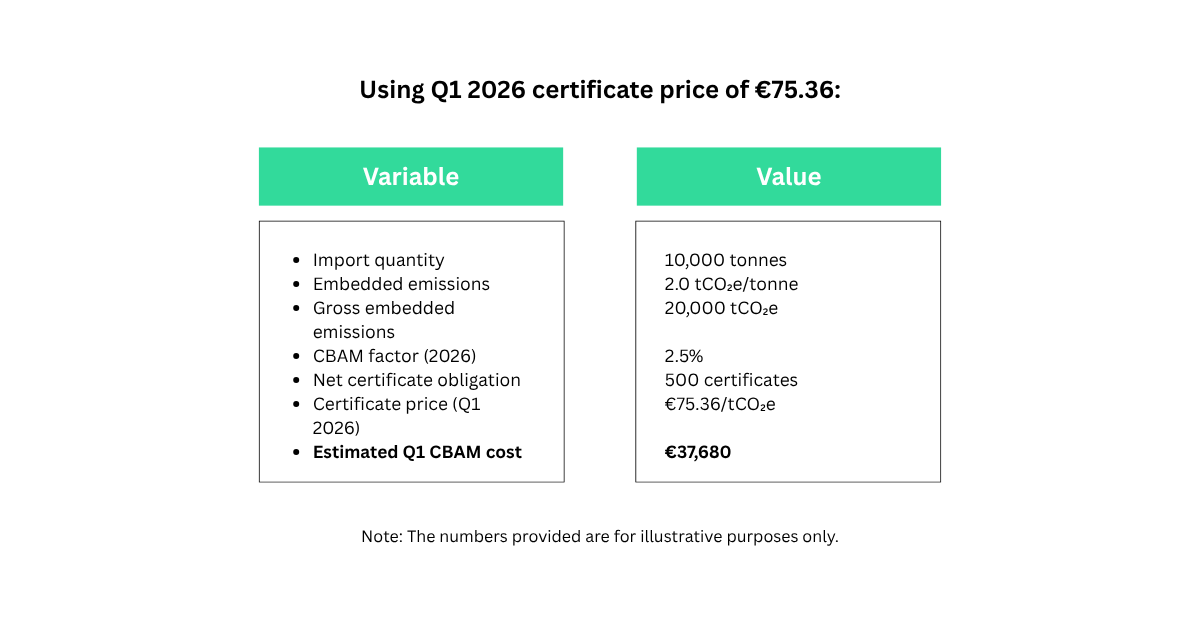
For the full year (assuming consistent volumes across all four quarters), total certificate liability would be approximately €150,720 — before any deductions for foreign carbon pricing.
Example 2: Aluminium — Default Values vs. Actual Emissions (China)
An EU importer sources 500 tonnes of unwrought aluminium (CN code 7601) from China. Their supplier has not yet provided verified emissions data.
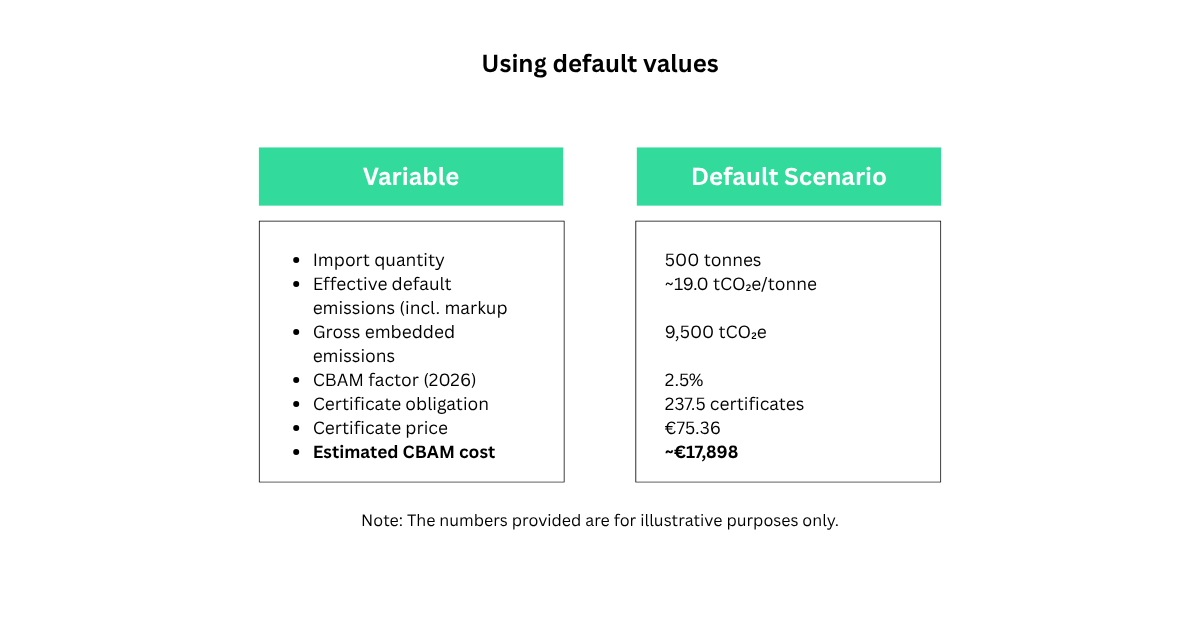
Using default values (China, unwrought aluminium):
Default embedded emissions for Chinese aluminium are approximately 17.3 tCO₂e per tonne, reflecting China’s coal-heavy power grid. With the 10% markup applied in 2026, the effective default becomes approximately 19.0 tCO₂e per tonne.
Using actual verified emissions (same supplier, cleaner production mix):
If the same supplier provides verified data showing actual emissions of 8.5 tCO₂e per tonne — reflecting a less carbon-intensive production route:
Variable | Verified Actual Scenario |
Import quantity | 500 tonnes |
Actual embedded emissions | 8.5 tCO₂e/tonne |
Gross embedded emissions | 4,250 tCO₂e |
CBAM factor (2026) | 2.5% |
Certificate obligation | 106.25 certificates |
Certificate price | €75.36 |
Estimated CBAM cost | ~€8,006 |
The cost of using default values versus actual verified data in this example: over €9,800 on a single 500-tonne shipment. Multiplied across a full year’s import volumes, the gap becomes a critical financial variable.
Example 3: Fertilisers — With Foreign Carbon Price Deduction
An EU importer brings in 2,000 tonnes of urea (a nitrogen-based fertiliser) from a producer in a country with a recognised domestic carbon pricing mechanism. The supplier provides verified emissions data of 2.3 tCO₂e per tonne. The verifiable carbon price already paid in the country of origin is €15 per tCO₂e.
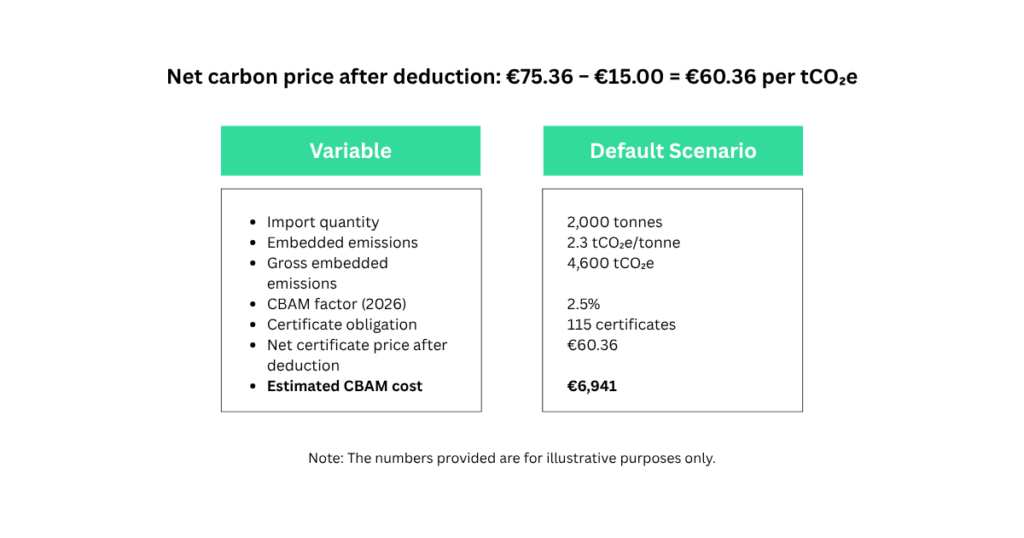
Without the deduction, the cost would have been €8,666 — a saving of €1,725 for this volume.
Why the CBAM Factor Matters More Than It Looks
The 2.5% CBAM factor in 2026 might create the impression that CBAM costs are modest and manageable for the foreseeable future. That would be a significant mistake in financial planning.
The factor increases every year. By 2030, the phase-in reaches 48.5%. By 2034, it hits 100%. A steel importer paying approximately €37,680 per quarter in Q1 2026 will face the equivalent of over €1.5 million per quarter for the same volumes and emissions intensity by 2034 — at current ETS pricing levels. The trajectory is not linear, and EU ETS allowance prices are widely forecast to rise as the cap tightens.
Businesses that treat 2026 as a low-stakes year because the factor is small are misjudging the curve. The right use of 2026 is to build the data infrastructure, supplier relationships, and financial modelling capability to manage a cost that will grow substantially over the next decade.
The Role of Verified Emissions Data in Keeping Costs Down
The single most impactful action an importer can take to reduce their CBAM exposure — beyond switching to lower-emission suppliers — is securing verified actual emissions data from every supplier of CBAM-covered goods. As the aluminium example above demonstrates, the difference between default values and actual verified data can be enormous, particularly for goods sourced from high-emission countries or production routes.
From 2026, actual emissions data used in a CBAM declaration must be verified by an EU-accredited third-party verifier. The verification process includes an on-site audit of the production installation in the first year and a strict 5% materiality threshold. If verification fails or is completed after the declaration deadline, the importer automatically reverts to default values with their penalty markup.
Investing in supplier data readiness now — including helping your key suppliers understand the EU’s methodology and build the required reporting systems — is not just a compliance activity. It is a direct cost management measure with a measurable return.
Key Deadlines to Build Your Cost Timeline Around
Understanding when costs crystallise is as important as knowing how to calculate them.
Costs accrue from: 1 January 2026 (on every qualifying import above 50 tonnes per year).
First annual CBAM declaration due: 30 September 2027 (covering all 2026 imports).
Certificate purchase window opens: 1 February 2027.
Certificate surrender deadline: 30 September 2027.
Quarterly holding requirement: Importers must hold certificates equal to at least 50% of embedded emissions from imports made since the start of the calendar year, at the end of each quarter.
Certificate pricing in 2026: Four quarterly prices, published in the first week following each quarter’s end. Q1 2026 price: €75.36/tCO₂e.
Certificate pricing from 2027: Weekly average EU ETS auction prices, published every Monday.
Using the CBAM Cost Calculator
To make it easier to model your exposure, the interactive CBAM Cost Calculator below lets you input your import volume, emissions intensity, certificate price, CBAM factor, and any eligible foreign carbon price deduction — and produces an instant cost estimate. You can toggle between using actual verified emissions and default value scenarios to see the cost difference for your specific situation.
Use the calculator as a planning tool, not a compliance submission — actual declaration figures must be based on verified data and official published prices for each quarter.
Frequently Asked Questions
What is the correct formula to calculate CBAM costs as an importer in 2026?
To calculate CBAM costs as an importer, use: CBAM Cost = Import Quantity (tonnes) × Embedded Emissions (tCO₂e/tonne) × CBAM Factor × Certificate Price (€/tCO₂e) − Foreign Carbon Price Already Paid. In 2026, the CBAM factor is 2.5%, reflecting the early phase-in of the mechanism. Certificate prices are published quarterly by the European Commission, with Q1 2026 set at €75.36 per tCO₂e. The embedded emissions figure should come from verified supplier data wherever possible; default values are available as a fallback but carry a 10% penalty markup in 2026, increasing to 30% from 2028.
Why does the CBAM factor matter, and how does it change over time?
The CBAM factor determines what proportion of total embedded emissions an importer must cover with certificates. It starts at 2.5% in 2026 and rises progressively each year, reaching 100% in 2034. This phase-in mirrors the gradual withdrawal of free EU ETS allowances from European producers. In practical terms, it means CBAM costs for the same import volume and emissions intensity will be roughly 40 times higher in 2034 than they are in 2026. Importers should model not just their 2026 exposure but their trajectory through to 2034 when building financial forecasts and procurement strategies.
What happens if I use default values instead of actual verified emissions to calculate CBAM costs?
If actual verified emissions data is unavailable, importers must use the EU’s country- and product-specific default values. These are intentionally set at the high end of recorded emission intensities and carry an additional markup — 10% in 2026, 20% in 2027, and 30% from 2028 onward. The financial impact can be substantial. In the aluminium example in this guide, using default values instead of verified actuals more than doubled the CBAM cost on a 500-tonne shipment. For importers sourcing from high-emission countries or production routes with no verified data, the cost penalty for relying on defaults will compound significantly as the CBAM factor rises toward 100% in 2034.
Can I deduct carbon costs already paid in the producing country when I calculate CBAM costs?
Yes. Where an importer can demonstrate that a carbon price was already paid in the country of production — through a domestic ETS, a direct carbon tax, or an equivalent mechanism that meets EU recognition criteria — that amount can be deducted from the CBAM certificate obligation. The deduction applies on a per-tonne basis. From 2027, the European Commission will also publish default carbon price values for countries with established pricing mechanisms where an actual paid price cannot individually be confirmed. This prevents the same tonne of CO₂ being charged twice — once in the producing country and again at the EU border.
What is the Q1 2026 CBAM certificate price, and where can I find updated prices?
The European Commission published the first official CBAM certificate price on 7 April 2026: €75.36 per tCO₂e for imports made in Q1 2026 (January–March). This was calculated as the weighted average auction clearing price of EU ETS allowances during the quarter. Three further quarterly prices will be published for Q2, Q3, and Q4 2026. Each is published in the first calendar week following the end of the relevant quarter. Updated prices are available directly on the CBAM section of the European Commission’s Taxation and Customs Union website. From 2027, prices will update weekly rather than quarterly, meaning importers will need to track a more frequently changing input in their cost calculations.