Steel is the backbone of modern civilisation — from skyscrapers and bridges to vehicles, appliances, and renewable energy infrastructure. Global crude steel production reached approximately 1.885 billion tonnes in 2024, powering economic growth while posing one of the largest industrial climate challenges. Understanding how is steel made reveals why the sector accounts for roughly 7–8% of global anthropogenic greenhouse gas (GHG) emissions, and why its emission implications of steel are central to discussions around decarbonisation and the future of “green steel.”
To standardise these efforts, the development of a Green Steel Taxonomy is becoming essential to define what truly constitutes low-carbon production. This guide explores the primary and secondary steelmaking routes in detail, their raw material requirements, and the significant carbon footprint associated with each
What Is Steel and Why Does Production Matter?
Steel is a mix mainly made of iron with a small, controlled amount of carbon (usually 0.02–2.1%) and other elements like manganese, silicon, chromium, or nickel to get properties like strength, flexibility, and resistance to rust. It is very useful, can be recycled, and is affordable. However, making steel from iron ore uses a lot of energy and produces a lot of carbon.
The choice of production route determines both quality and environmental impact. Globally, about 70–73% of steel comes from primary production using iron ore, while the remainder relies more on recycled scrap. These routes differ dramatically in emission implications of steel.
Main Routes: How Is Steel Made?
There are two dominant commercial pathways for how is steel made:
- Blast Furnace – Basic Oxygen Furnace (BF-BOF) route (primary/virgin steelmaking) — ~70–73% of global production.
- Electric Arc Furnace (EAF) route (secondary/recycling-focused), often using scrap or Direct Reduced Iron (DRI) — ~27–30% of global production.
A third variant, natural gas-based DRI-EAF, accounts for a smaller but growing share (~5–7%).
1. BF-BOF Route: The Traditional Integrated Process
This coal-based integrated route produces “new” steel from raw materials. It dominates in regions with abundant iron ore and coal, including much of Asia.
Step-by-step process:
- Raw Material Preparation: Iron ore (primarily hematite Fe₂O₃ or magnetite Fe₃O₄) is mined, crushed, and often sintered or pelletised. Coking coal is converted into coke in coke ovens (heating in the absence of air). Limestone (CaCO₃) acts as a flux.
- Blast Furnace (BF) – Ironmaking: Layers of iron ore, coke, and limestone are charged into a massive vertical furnace (up to 30–40 metres tall). Preheated air (hot blast) is blown in at the bottom. Coke serves dual roles: as fuel (providing heat) and as a reducing agent. Carbon in coke reacts with oxygen in the iron ore, removing it as CO₂ and producing molten pig iron (hot metal) containing ~4–5% carbon plus impurities. The reaction is exothermic and reaches ~1,500–2,000°C. Limestone helps form slag that captures impurities like silica. Typical inputs per tonne of crude steel: ~1,370 kg iron ore, ~780 kg metallurgical coal (for coke), ~270 kg limestone, and some scrap.
- Basic Oxygen Furnace (BOF) – Steelmaking: Molten pig iron is transferred to the BOF converter. Pure oxygen (>99.5%) is blown at supersonic speed through a lance, oxidising excess carbon, silicon, and other impurities. This generates intense heat, allowing addition of up to ~20–30% scrap steel. The process takes 30–40 minutes per “heat” and produces liquid crude steel with ~0.1–1% carbon. Slag is removed, and the steel is refined.
- Secondary Steelmaking and Casting: Ladle metallurgy adjusts chemistry (alloying, deoxidation, desulphurisation). The molten steel is then continuously cast into slabs, blooms, or billets, which are rolled into final products (plates, coils, sections, etc.).
The BF-BOF route is highly efficient in large integrated mills but inherently carbon-intensive due to the use of fossil carbon as both energy source and chemical reductant.
2. EAF Route: Recycling and Flexibility
How is steel made via EAF is fundamentally different — it melts solid metallic feedstock using electricity.
- Feedstock: Primarily steel scrap (from end-of-life products or manufacturing waste). Increasingly supplemented by Direct Reduced Iron (DRI) or Hot Briquetted Iron (HBI) when scrap is scarce or for quality reasons. DRI is produced by reducing iron ore pellets in a shaft furnace using a reducing gas (natural gas, coal, or increasingly hydrogen).
- Electric Arc Furnace: Scrap/DRI is charged into a refractory-lined vessel. Graphite electrodes create an electric arc (temperatures up to 1,800°C), melting the charge. Oxygen lancing and chemical reactions refine the melt. Additives adjust composition. A “heat” takes 45–90 minutes. Modern EAFs are highly productive and flexible, allowing rapid grade changes.
- Downstream: Similar secondary refining, continuous casting, and rolling as in BF-BOF.
In the US, EAF accounts for ~70–75% of production due to high scrap availability and lower emissions. Globally, the share is rising but constrained by scrap supply and electricity costs/quality.
DRI Production: In DRI-EAF, iron ore is reduced at lower temperatures (~800–1,200°C) without melting, using syngas (from natural gas or coal) or hydrogen. The resulting sponge iron is then fed to EAF. Coal-based DRI is common in India; gas-based in regions with cheap natural gas.
Emission Implications of Steel: Quantifying the Carbon Footprint
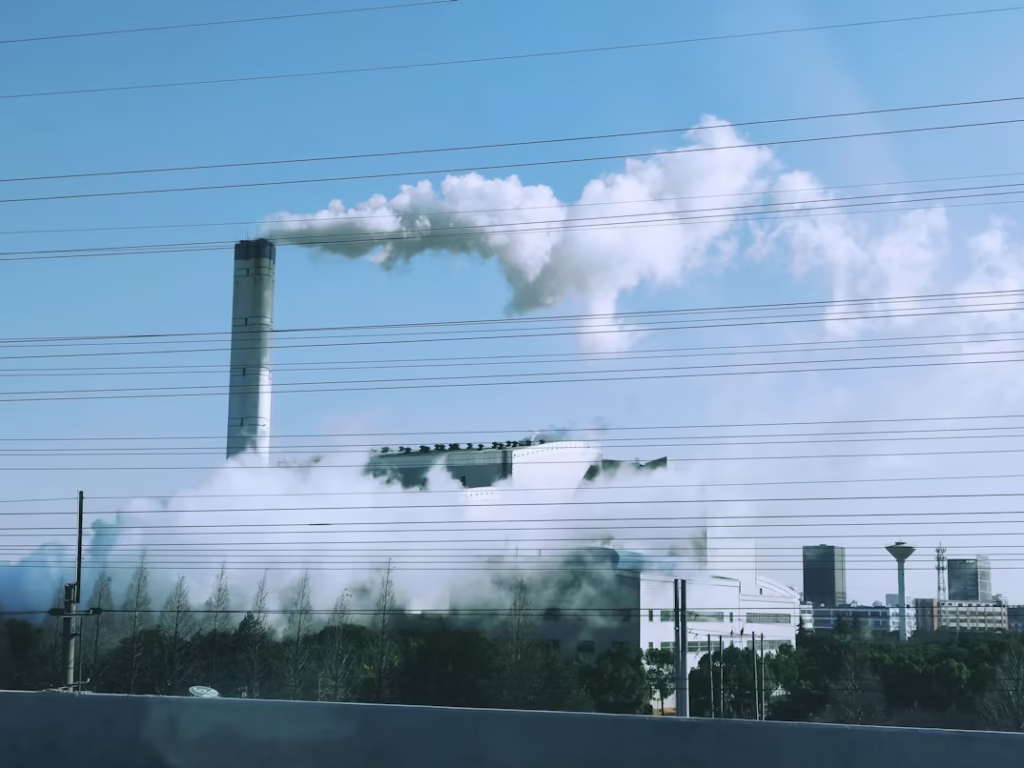
The emission implications of steel are stark and route-dependent. The global average stands at approximately 1.92 tonnes CO₂ per tonne of crude steel (tCO₂/tcs) based on recent data, though figures vary by methodology and inclusion of upstream emissions.
- BF-BOF Route: Typically 2.0–2.34 tCO₂/tcs (or higher in less efficient plants). The majority (~70–80%) comes from the blast furnace: coke combustion/reduction produces CO₂ directly, plus emissions from coking, sintering, and limestone calcination (CaCO₃ → CaO + CO₂). Indirect emissions arise from electricity and transport. In coal-heavy regions, intensity can exceed 2.5 tCO₂/tcs.
- Scrap-based EAF: Far lower — around 0.4–0.7 tCO₂/tcs, primarily from electricity consumption and minor process emissions. With a clean renewable grid, this can drop below 0.4 tCO₂/tcs. The high recyclability of steel (up to 90%+ recovery rates) makes this route circular and low-carbon.
- DRI-EAF: 1.36–1.47 tCO₂/tcs on average when using natural gas or coal-based reduction. Coal-DRI (prevalent in India) pushes emissions higher, sometimes approaching BF-BOF levels due to the reducing agent and electricity/grid factors. Hydrogen-based DRI (H₂-DRI) can reduce this dramatically — potentially to near-zero when paired with renewable electricity for EAF and green hydrogen production.
Global Context and Regional Variations:
- Steel contributes 7–8% of worldwide GHG emissions, equating to over 4 billion tonnes CO₂e annually in recent years.
- Europe and North America benefit from higher EAF shares and better efficiency/cleaner grids, achieving lower averages (~1.6–1.8 tCO₂/t in mixed routes).
- In India, the average is higher — often cited at 2.5 — 2.55 tCO₂/tcs or more — due to a heavy reliance on coal-based BF-BOF and coal-DRI routes, lower-grade ores, and a coal-dominated electricity grid. The sector accounts for about 12% of India’s total CO₂ emissions. Chinese production also tends toward higher intensities in BF-BOF dominant mills.
Emissions occur across the value chain: raw material extraction and processing (~10–20%), ironmaking (dominant in primary routes), steelmaking, and downstream forming. Scope 1 (direct) and Scope 2 (electricity) dominate, but full life-cycle assessments include mining and transport.
Why Emissions Are So High: Key Drivers
- Chemical Reduction: Removing oxygen from iron ore requires a reductant. In BF, carbon from coke is the cheapest and most effective, but it generates CO₂ stoichiometrically.
- High Energy Demand: Steelmaking is one of the most energy-intensive industries. BF-BOF requires ~20–24 GJ/t, while scrap EAF needs ~10 GJ/t or less.
- Process Inefficiencies and Legacy Plants: Older facilities, lower-grade raw materials (high ash coal or low-grade ore in India), and coal-heavy power grids amplify footprints.
- Scale and Growth: Rising demand, especially in developing economies, locks in emissions if new capacity follows traditional routes.
These emission implications of steel create trade tensions. From 2026, the EU’s Carbon Border Adjustment Mechanism (CBAM) will require importers to track emissions and provide certificates. It is clear that CBAM Will Reshape the Steel Industry by forcing a global shift in how carbon is valued. This includes a strict CBAM for iron and steel sector compliance, where CBAM for Iron and Steel imports will be taxed based on their carbon intensity.
Navigating the CBAM & Iron/Steel landscape requires precise CBAM Reporting to avoid heavy penalties. To manage this data, many firms are now adopting a Carbon Accounting Platform to automate the tracking of embedded emissions. This is putting price pressure and making buyers ask for low-carbon steel, which is already changing supply chains.
Pathways to Reduce Emission Implications of Steel
Decarbonising steel is technically feasible but capital-intensive. Key strategies include:
- Maximising Scrap Use: Boosting EAF share globally. However, high-quality scrap is limited, and quality dilution can occur without virgin iron inputs.
- Efficiency Improvements: Best Available Techniques (BAT), energy recovery (e.g., top-pressure recovery turbines, coke dry quenching), and process optimisation can cut 10–20% of emissions in existing plants.
- Alternative Reducing Agents: Injecting hydrogen, biomass, or plastic waste into blast furnaces as a transitional measure.
- Hydrogen-Based DRI-EAF (Green Steel): Replacing fossil reductants with green hydrogen (produced via electrolysis using renewable electricity) offers >80–95% emission reductions. Hot charging DRI into EAF enhances efficiency. Challenges include hydrogen cost, scale-up of electrolysers, and renewable power availability. Pilot and demonstration projects are advancing in Europe, with growing interest elsewhere.
- Carbon Capture, Utilisation and Storage (CCUS): Retrofitting BF-BOF or DRI plants to capture CO₂ for storage or use (e.g., in chemicals). Promising for existing assets but adds cost and requires storage infrastructure.
- Electrification and Renewables: Powering EAFs and auxiliary processes with green electricity; exploring molten oxide electrolysis or other novel routes.
- Circular Economy and Material Efficiency: Designing products to last longer, be reused, and recycled more. Industry goals, like those from the World Steel Association and national plans, aim to greatly reduce emissions by 2030. They also plan to reach net-zero emissions by 2050 using a mix of these technologies. In India, the government is encouraging green steel with rating systems and aims to reduce emissions to 2.2 tCO₂/tcs or less, as well as promoting the use of scrap and alternative methods.
The Road Ahead: Balancing Demand and Decarbonisation
How is steel made today is still largely a fossil-carbon story, explaining its substantial emission implications of steel. Yet the sector’s long asset life (30–50+ years for integrated plants) means decisions taken now will shape emissions for decades. Transitioning requires massive investment in technology, infrastructure (renewables, hydrogen, CCUS), policy support (carbon pricing, green premiums, public procurement), and international collaboration to avoid carbon leakage.
For exporters, especially in busy regions, it is becoming important to adapt early. This means doing things like reporting emissions accurately, working with suppliers to get better data, and investing in ways to reduce carbon. This is necessary because of rules like CBAM and what buyers now expect.
Steel is strong because it can be recycled and lasts a long time. For steel to have a good future, we need to make its production process as eco-friendly as the steel itself. By using scrap-EAF when we can, increasing green hydrogen DRI, using CCUS, and making things more efficient, the industry can keep helping to create a world with less carbon, just like it built the world we have now.
The transformation of how is steel made will be one of the defining industrial shifts of the 21st century — driven by climate imperatives, technological innovation, and economic realities.