
California Climate Disclosure SB 253 & SB 261 Compliance Services
- Automate Your California Climate Disclosure Now
- Avoid Penalties—Prepare for SB 253 Compliance Services Now
Book your consultation at

California Sets the Standard in Climate Transparency
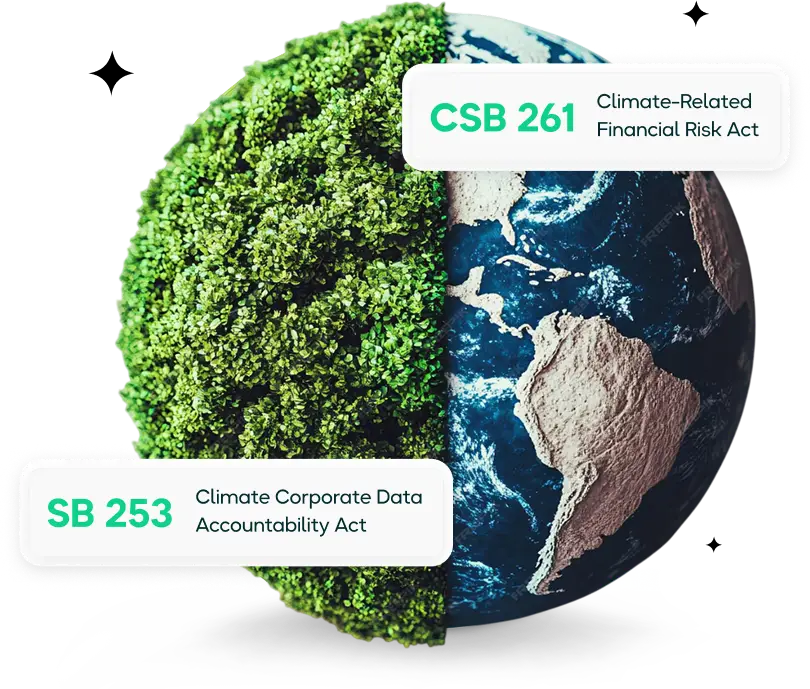
California has passed two groundbreaking california climate disclosure laws that will transform how companies report on sustainability:

SB 253 compliance services – Climate Corporate Data Accountability Act
Companies with over $1 billion in annual revenue doing business in California must disclose Scopes 1, 2, and 3 greenhouse gas emissions, verified by third-party assurance providers.
SB 261 Compliance – Climate-Related Financial Risk Act
Companies with over $500 million in annual revenue must file public reports on climate-related financial risks and the strategies in place to mitigate those risks.
With California ranked as the 4th largest economy in the world, these laws are more than state policy — they are setting a national and global benchmark for climate accountability.
Key Deadlines You Can’t Ignore
The clock is ticking. Companies must start preparing now.
2026
Report Scope 1 & 2 emissions for FY2025 with limited assurance
2027
Report Scope 3 emissions for FY2026 across your value chain.
2030
Obtain reasonable assurance for Scope 1 & 2, and limited assurance for Scope 3.

Why CleanCarbon is Your California Compliance Partner?
At CleanCarbon, we’ve already delivered 10,000+ california climate disclosure and ESG reports for 300+ companies worldwide — spanning industries from technology and automotive to steel, aluminum, and energy.
Now, through our U.S. entity CleanCarbon in Palo Alto, we bring this expertise to help California businesses get ahead of SB 253 compliance services and SB 261 compliance.
Step
01
Silicon Valley–Grade Carbon Intelligence
- Cloud-native, AI-driven platform for real-time carbon footprinting.
- Built for enterprise scale — from startups to Fortune 500s.
- Integrated with GHG Protocol, PCAF, and global emission factor databases.
Step
02
Audit-Ready California Climate Disclosure
- Every data point is traceable, verifiable, and audit-ready.
- Aligns with third-party assurance standards mandated under SB 253.
- Defends against greenwashing claims and reputational risk.
Step
03
Scope 3 Made Simple
- Supplier engagement portals to collect value-chain emissions.
- AI-driven gap-filling when supplier data is missing.
- Collaboration tools for onboarding suppliers, vendors, and partners.
Step
04
Climate Risk & Financial Impact Analytics
- Integrated risk modeling for wildfires, floods, and heat stress in California.
- Transition risk scenarios (policy, carbon pricing, regulation).
- Aligns with TCFD, SEC proposals, and global frameworks for SB 261 reporting.
What
Sets Us Apart


Proven Globally, Ready Locally
- 10,000+ ESG reports delivered across Europe, Canada, and Asia. Now tailored for California CARB compliance

Palo Alto Headquarters
- Local presence to support Silicon Valley and California enterprises

Technology-First Approach
- Unlike consultancy-heavy firms, our platform + advisory model gives you speed, scalability, and accuracy.

End-to-End Support
- From data collection to climate disclosure strategy, we cover the full compliance journey.

Insights to Keep You Ahead
- CARB Preliminary List Released: What companies need to know about SB 253 and SB 261.
- Top SB 261 Questions Answered: How to prepare for climate risk disclosure.
- California Climate Disclosure Guide: A roadmap for executives and sustainability leaders.
Frequently Asked Questions
01 Who qualifies for california climate disclosure requirements?
Companies “doing business” in California with annual revenues exceeding $1 billion must comply. This includes public and private companies, as well as subsidiaries if the parent company meets the revenue threshold. The law applies to entities that engage in any transaction for financial gain within California, regardless of where they are headquartered.
02 What are the reporting deadlines?
Scope 1 and 2 emissions require limited assurance reporting for fiscal year 2025, with filings due in 2026. Scope 3 emissions must be reported for fiscal year 2026, with reasonable assurance for Scope 1–2 and limited assurance for Scope 3 required by fiscal year 2027. Companies should begin data collection immediately to meet these timelines.
03 What is Scope 3 and why is it challenging?
Scope 3 covers all indirect emissions across your value chain, including purchased goods, transportation, employee commuting, and product end-use. It is challenging because it requires data from suppliers, customers, and partners outside your direct control. CleanCarbon helps streamline this complex data collection through our platform and supplier engagement tools.
04. What is the current status of SB 261 compliance?
SB 261, which mandates climate-related financial risk disclosures, is currently facing legal challenges. A federal judge issued a preliminary injunction blocking enforcement while litigation continues. However, companies should still prepare for potential reinstatement, as the ruling may be appealed or modified. CleanCarbon monitors these developments to keep clients informed.
05. What are the penalties for non-compliance?
Companies failing to report face penalties up to $500,000 per violation. The California Air Resources Board (CARB) can pursue enforcement actions, and non-compliance may also expose companies to litigation risks from investors or stakeholders. Proactive preparation and accurate reporting are essential to avoid these significant financial and reputational consequences.
06. How do subsidiaries factor into california climate disclosure?
Subsidiaries are included if their parent company meets the $1 billion revenue threshold, even if the subsidiary itself is smaller. The parent company must consolidate emissions data from all qualifying subsidiaries in their report. CleanCarbon helps structure data collection across complex corporate hierarchies to ensure comprehensive, compliant reporting.
07. Do private companies need to comply?
Yes, unlike the SEC’s climate disclosure rules, California’s laws apply to private companies meeting the revenue threshold. This significantly expands the compliance burden beyond publicly traded entities. Private companies must prepare the same level of emissions accounting, assurance, and reporting as public companies, requiring early preparation and specialized expertise.
Get Expert CBAM Support
Our Palo Alto team works directly with California businesses to make carbon footprinting, ESG reporting, and climate risk disclosure simple, accurate, and audit-ready.
Latest Blogs

From supplier data collection headaches to mandatory third-party verification and integration with customs systems, automated tools address the core pain...


The EU’s Carbon Border Adjustment Mechanism (CBAM) poses a significant challenge to Indian automotive manufacturers, potentially increasing export costs by...
The CBAM authorised declarant status becomes mandatory for EU importers of CBAM goods from 2026. Businesses must meet strict requirements...