
Mandatory CBAM Reporting From Jan 2026. Submit Verified CBAM Report or Face EU Penalties.
CBAM Reporting and Compliance Services in Thailand
- CBAM consulting in Thailand
- Forecast your CBAM tax
- CBAM-proof you supply chain
Book your consultation at
Globally Trusted for CBAM Reporting




































What is CBAM?
The Carbon Border Adjustment Mechanism (CBAM) is the EU’s new climate regulation that requires companies exporting certain goods into the European Union to disclose their embedded carbon emissions.
During the transitional phase (2023–2025), EU importers must submit quarterly CBAM reports, which depend heavily on accurate emissions data from their suppliers in Thailand. Moreover, CBAM reporting becomes mandatory from January 2026 and the importers are mandated to pay carbon tax as per the embedded carbon emissions in their product.
Why CBAM Matters for Thailand Businesses?
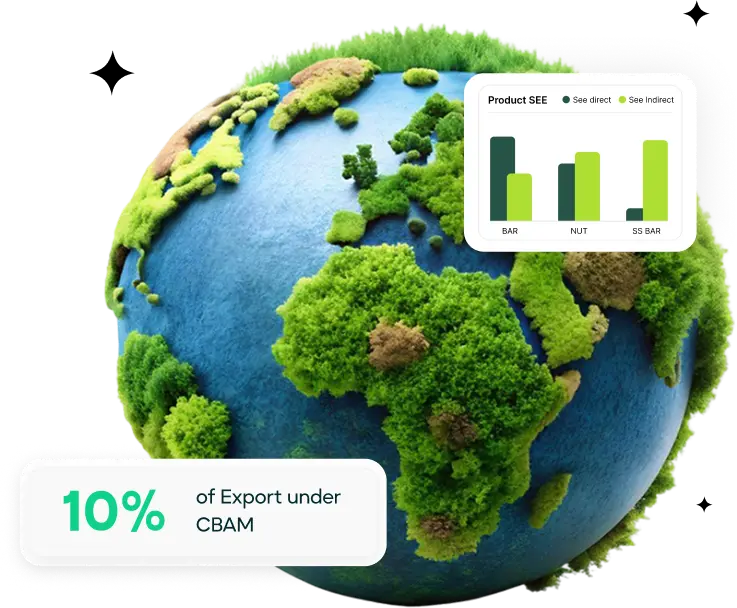
Thailand exports to the European Union stands at 10% of its total export to the EU, which is the 4th largest export destination. Moreover, 1.49% of its total export to the EU is under CBAM, majorly impacting the iron and steel industry. Other reasons CBAM matters for Thai businesses are:
- Thailand is a major exporter of steel, aluminium, cement, fertilizers, and other CBAM-covered products.
- EU buyers now demand verified carbon footprint data from Thai suppliers.
- Companies without proper reporting risk losing access to EU markets or being assigned higher emission default values.
For Thailand’s manufacturing and export sector, CBAM is becoming a key factor in maintaining competitiveness and supply chain reliability.
Who Needs CBAM Reporting in Thailand?
Any Thai company exporting CBAM-regulated goods to the EU must provide emissions data to help their EU importers file CBAM reports.
Industries currently covered by CBAM:

Iron and Steel

Aluminium

Fertilizers

Cement

Electricity

Hydrogen
You need CBAM reporting if you are:
- A Thai manufacturer shipping CBAM-covered products to EU customers
- An exporter or trader supplying regulated goods
- An EU importer sourcing products from Thailand
- A processing unit within the supply chain of CBAM-regulated industries
Even small exporters are required to provide emissions information during the transitional phase.

Our CBAM Services for Thailand Companies
Clean Carbon provides complete CBAM support designed for Thailand’s industrial and export landscape.


Product Carbon Footprint (PCF) Calculation
- Facility-level and product-specific emissions
- Fuel, raw material, electricity, and process emissions
- Calculations aligned with EU CBAM methodology

CBAM Data Collection & Documentation
- Activity data templates customized for Thai factories
- Verification-ready documentation
- Data gap handling and evidence management

Quarterly CBAM Reporting Support
- Preparing emissions datasets for EU importers
- Report formatting, structuring, and submission guidance
- Transitional-phase compliance checks

Supplier–Importer Coordination
- Aligning Thai suppliers with importer reporting systems
- Ensuring data accuracy and timely delivery
- Supporting importers during CBAM submissions

Training for Thai Businesses
- CBAM regulation training for engineering and sustainability teams
- Workshops on data collection and GHG accounting fundamentals

Full Compliance & Monitoring
- Continuous updates as CBAM rules evolve
- Annual data reviews
- Roadmaps for emission reduction and verification readiness (2026 onward)
How We Help with CBAM Compliance and Reporting?
Clean Carbon follows a structured, proven approach to ensure full CBAM compliance for Thai exporters.
01
Assess Your Factory & Product Scope
We identify which processes, materials, and product categories fall under CBAM.
02
Data Collection
Gathering accurate facility-level and product-level data:
- Electricity and fuel use
- Emissions from processes
- Raw material inputs
- Production volumes
03
Emissions Calculation (CBAM-Compliant)
We calculate:
- Direct emissions
- Indirect emissions
- Process emissions
- Embedded carbon using the latest CBAM approach
04
Preparing Importer-Ready Reports
We produce structured CBAM data files that importers can directly upload into the EU system.
05
Continuous Support & Audits
As rules evolve, we ensure that your reporting remains accurate and up-to-date.
- Ongoing monitoring
- Document maintenance
- Preparing for third-party verification from 2026
Our goal is to make CBAM easy, accurate, and hassle-free for Thai exporters.
Why Choose Clean Carbon for CBAM in Thailand?
Specialised CBAM Expertise
We focus exclusively on CBAM, carbon reporting, and EU compliance.
Experience with Thai Manufacturing
We work with leading exporters across Thailand’s steel, aluminium, cement, and fertilizer sectors.
EU-Compliant Calculations
All methodologies follow EU CBAM guidance, ISO standards, and GHG Protocol.
Fast & Reliable Reporting
We deliver precise CBAM-ready data within tight importer deadlines.
Seamless Supply Chain Coordination
We bridge the gap between Thai exporters and EU importers.
Transparent, Audit-Ready Outputs
Your data is prepared to meet 2026 verification requirements from day one.
Frequently Asked Questions (CBAM Thailand FAQs)
01 Is CBAM mandatory for Indonesian companies?
Yes. If you export CBAM-covered products to the EU, your importer must report the carbon emissions — and they need data directly from you.
02 What happens if I don’t provide CBAM emissions data?
Your EU buyer will use default values, which are usually higher than actual emissions.
This makes your product appear more carbon-intensive — reducing competitiveness.
03 Does CBAM apply during the transitional phase (2023–2025)?
Yes. Reporting is required, but no payment of carbon tax yet.
Accurate reporting is important to avoid penalties or disrupted shipments.
04 What emissions data do I need to provide?
Typically:
- Fuel consumption
- Electricity use
- Production volumes
- Process emissions
- Raw material data
We help you collect everything correctly.
05 Will CBAM require third-party verification?
Yes — starting 2026. Clean Carbon prepares your data to be verification-ready.
06 Is CBAM only for large exporters?
No. Even small shipments to the EU must include emissions data.
Get Expert CBAM Support in Thailand
Latest Blogs

Learn how to calculate CBAM costs as an importer in 2026 using the official EU formula, real-world examples, and a...

Discover how a CBAM consultant helps Indian exporters stay compliant with EU CBAM regulations and minimize the risk of penalties....
CBAM is reshaping global trade by making carbon emissions a key factor in pricing and market access. This guide explains...


Copyright ©2026cleancarbon– All Rights Reserved.